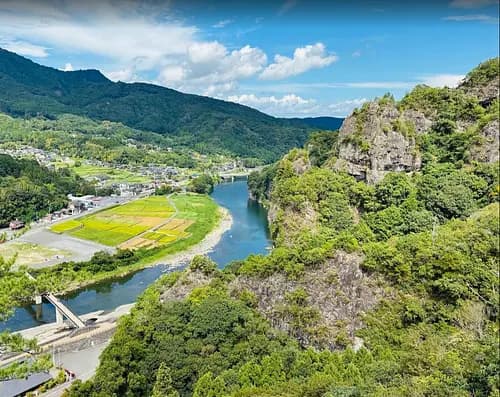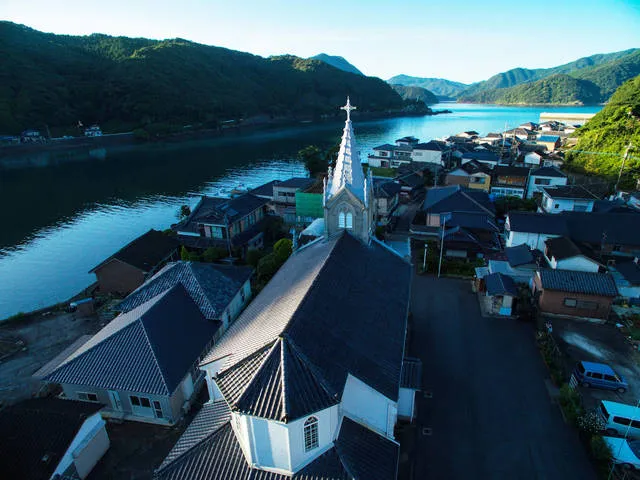
Sakitsu village is a new addition to the UNESCO’s World Heritage list, together with 11 other hidden Christian sites in the Nagasaki region.Learn about how the people in Satsuki village continued to live as Christians in secret when Christianity was banned in Japan.Learn how they passed on their Christian faith for 250 years under severe circumstances and found vestiges from the hidden Christian period.
Sakitsu Village, a UNESCO World Heritage Site
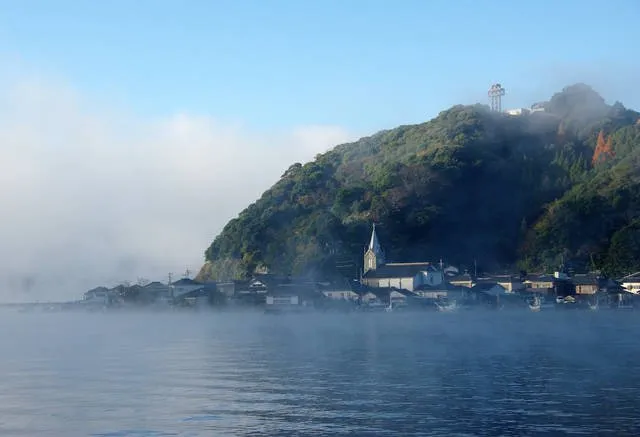 In July 2018, Sakitsu, a quiet fishing village in Shimoshima island, the largest of the Amakusa Islands in Kumamoto Prefecture and not far from Nagasaki, was designated UNESCO World Heritage together with 11 other Hidden Christian sites in the Nagasaki area. Also designated an Important Cultural Asset of Scenic Beauty in 2011, it is a beautiful village with roughly a 250-year history of Japanese people hiding their religious faith at a time when committing to the Christian faith was prohibited by the government.
History of Hidden Christians in Japan
 Up until the 1530’s, Japan relied on traditional Chinese medicine, and most people practiced some combination of Buddhism and Shinto. Things started to change after the first Europeans set foot in Japan in 1543, which marked the beginning of the population’s exposure to European culture, such as Western medicine, physics and Christianity. In 1549, Francis de Xavier, a Basque Roman Catholic missionary, landed in Kyushu, the southernmost island of Japan’s four largest islands, to convert as many Japanese to Catholicism as possible.
Christianity flourished in many regions. In 1569, Luis de Almeida, a Jesuit and certified Portuguese doctor, landed in Amakusa islands for missionary work. There, he converted five feudal lords to Catholics, who then used the top-down method to impose Christianity on the people under his rule. From 1591 to 1597, Luis de Almeida constructed a Theological Seminary where he taught people physics and languages. Many Christian devotional tools were brought to Sakitsu from Europe and the village quickly became an important port for missionaries.
Seeing the amount of influence Western thinking had on its people, Japan’s ruler Toyotomi Hideyoshi began to see Christianity as a serious threat to Japanese civilization. He banned Christianity but continued trade with European countries, making it hard to completely stop Christianity from spreading. His successor, a Tokugawa shogun, made it his mission to prohibit it completely.After the Shimabara Rebellion in 1637, an uprising of Japanese Christians against the government, the Tokugawa shogunate completely banned the practice of Christianity in Japan by deporting all missionaries, destroying churches, and limiting international trade to three countries: Holland, China and Korea. The shogunate employed a range of forceful measures, resulting in many Christians being martyred.
While most Japanese Christians pledged allegiance to Buddhism or Shinto under these circumstances, many Japanese Christians in Nagasaki and Sakitsu continued their faith in secret, only masking themselves as registered Buddhists or Shintoists. In areas where Christians had lived, there would be annual checks by the government to make sure residents have denounced their faith. They did so by asking residents to trample on an image of Virgin Mary or Jesus Christ – a practice called efumi in Kyushu.
Many residents of Sakitsu village would wear new waraji straw sandals on the day of efumi. Once they came back home, it is said they brewed a drink with the sandals, drank it and prayed for forgiveness from god. Although many Nagasaki residents were arrested for not cooperating with efumi, arrests in Sakitsu were unheard of.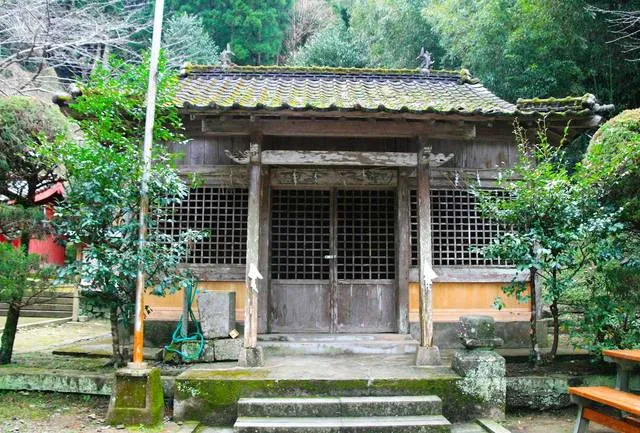 In 1805, 5,205 people in Amakusa Islands were exposed as hidden Christians including 1,709 people from Sakitsu village, which was 70% of the village’s population. With nobody fighting back and everybody paying taxes, they were only asked to do efumi, and discard objects of worship.
Until the lift in prohibition in 1873, the hidden Christians in Sakitsu continued their religious faith in secret, which resulted in religious customs endemic to Sakitsu village. They substituted pearl patterns of abalone and mussel shells as the Virgin Mary. They pretended to be Shintoists and prayed at Sakitsu Suwa Shrine, striving hard to keep their faith without getting caught. When freedom of religion was officially recognized, the hidden Christians in Sakitsu revealed themselves, surprising the world that even under such severe circumstances, they had passed on their Christian faith for hundreds of years.
Places to Visit in Sakitsu
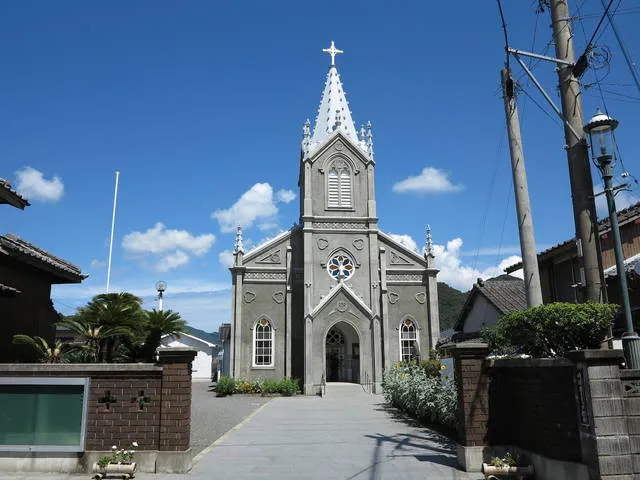
Picture provided by: Amakusa Treasure Island Tourism Association (写真提供:一般社団法人 天草宝島観光協会)
The first Sakitsu church was built in 1888 along the Sakitsu Suwa Shrine. It symbolizes a new era where it was no longer necessary to hide one’s faith. It was relocated due to aging, and on the site there is now a convent building. In 1934, the local community built Sakitsu Catholic church on the site that used to be the place where efumi took place. The Gothic church floor is covered with tatami mats, which is unusual in Japan, symbolizing the mixture of Western and Japanese cultures.
Artifacts used as hidden objects of worship are on display at the Minatoya Sakitsu Museum. As you walk through the village and the surrounding mountains, you will spot vestiges of the hidden Christian period.
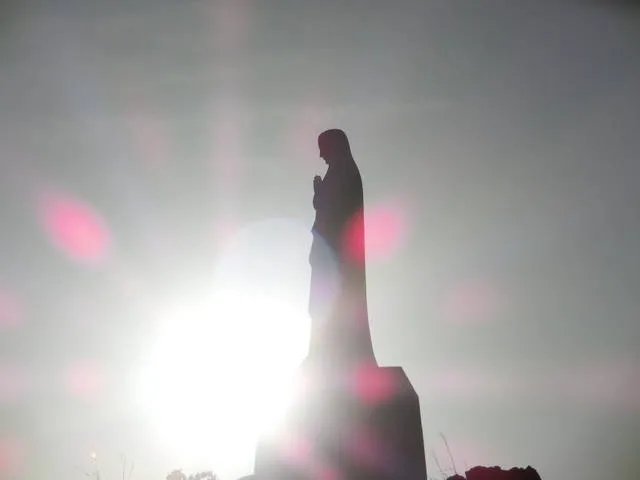
A “Statue of Mary on the Ocean” by Sakitsu’s Yokaku bay gazes at the ocean in front of her. Sakitsu fishermen pray to this statue for their safety when sailing to sea. It is no surprise that even to this day, most of the fishermen in Sakitsu are Catholics.
How to Visit
Take the plane from Tokyo to Aso-Kumamoto Airport (1.5-2 hours), then take the Amakusa Airlines from Aso-Kumamoto Airport to Amakusa aiport (20 min). If you can rent a car or go by taxi, a drive from Amakusa airport to Sakitsu is the easiest and fastest way to get to Sakitsu village (45 min).If you cannot take the car, you can also go by bus. From Amakusa Airport, get on a bus bound for Hondo Bus Terminal (15 min). From Hondo Bus Terminal, take the Kyushu Sanko bus to Shinmaruyama Icchoda stop (60 min), then transfer to the bus bound for Shimoda Onsen and get off at Sakitsu Church stop (10 min). Since buses are not that frequent, be prepared for a lot of waiting in between transfers.
Sakitsu Catholic Church
Address: 539, Sakitsu, Kawaura-machi, Amakusa-shi, Kumamoto prefecture 863-1204
Tel: +81-969-22-2243
Reference List
http://www.city.amakusa.kumamoto.jp/sakitsu-sekai/
https://www.t-island.jp/en/