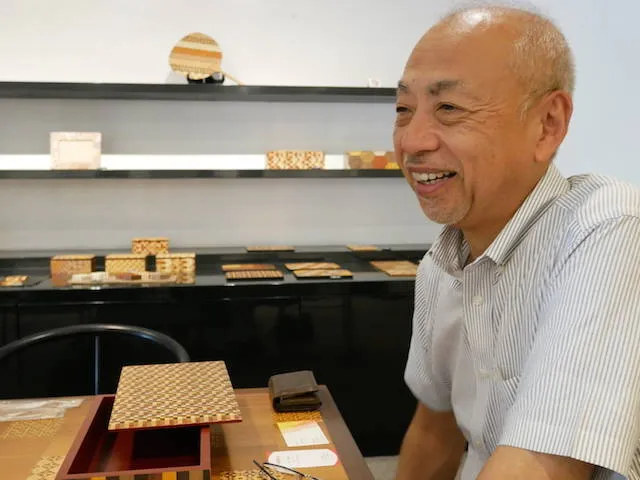
content: Hakone Yosegi-Zaiku is a special type of traditional Japanese marquetry, created in the hot-spring town of Hakone in Kanagawa prefecture. In this article, we introduce Mr. Kiyokatsu Tsuyuki, a master Hakone Yosegi-Zaiku craftsman and owner of a family-run woodworking plant.
Summary
Hakone Yosegi-Zaiku is a special type of traditional Japanese marquetry, created in the hot-spring town of Hakone in Kanagawa prefecture. In this article, we introduce Mr. Kiyokatsu Tsuyuki, a master Hakone Yosegi-Zaiku craftsman and owner of a family-run woodworking plant. We will also cover his thoughts on Hakone Yosegi-Zaiku’s past and future.
Wood Crafts Have Always Been Made in this Area
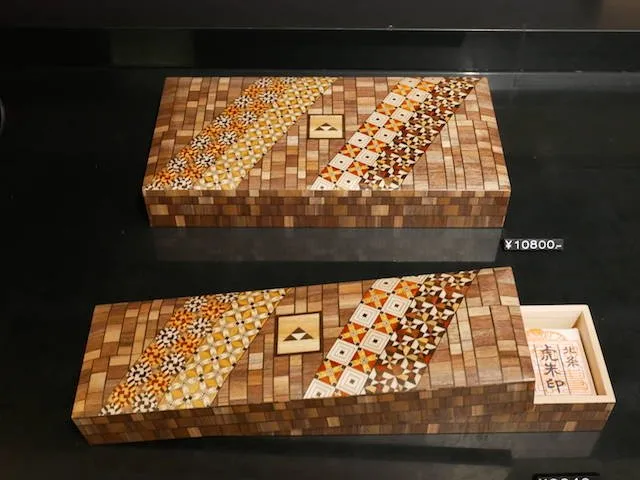 Collaboration with a Japanese sweets shop in Odawara. Tsuyuki woodworking plant was asked to make a Hakone Yosegi-Zaiku box for a historical anniversary. Interviewer: Could you tell us about the history of your woodworking plant, and how the Hakone Yosegi-Zaiku began?
Kiyokatsu Tsuyuki: Hakone Yosegi-Zaiku is thought to have developed in the late Edo period (1603-1868) in the Hatajuku district of Hakone. It is said that the wood craftsman Nihei Ishikawa was the first creator, who then passed on the techniques to others. My grandfather who was born and raised in the Hatajuku district, met the creator’s grandson, Nisaburo Ishikawa. After graduating from elementary school, my grandfather lived and worked for Nisaburo Ishikawa until he mastered the techniques necessary to be on his own. He then opened his business in Odawara city in Kanagawa when he was 20 years old.
The Hakone Yosegi-Zaiku itself may only have 200 years of history but I have to add that the Hakone and Odawara areas have a history of wood crafts for over a thousand years. From back then, craftsmen here were making wooden bowls, trays and other wooden crafts that were used for everyday life. That developed into another traditional craft called Odawara lacquerware (Odawara shikki). In the 1600’s, more tools were developed and a wider variety of things such as wooden boxes were made. The Hakone and Odawara areas have always been abundant with nature, and there is a whole variety of trees here. Wooden crafts have always been a part of life in this area. 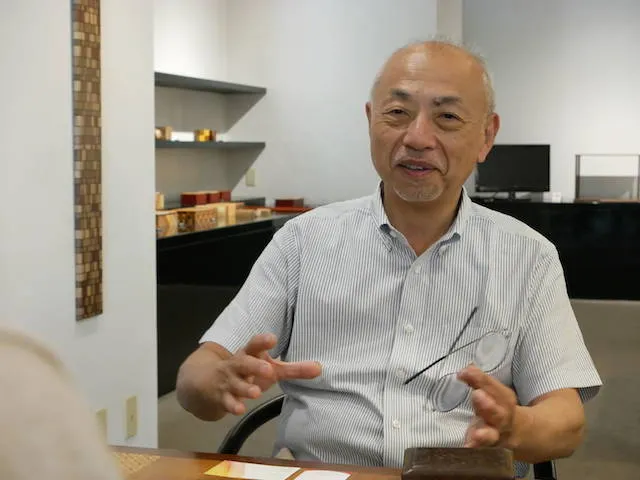 Interviewer: Were the techniques used to make Hakone Yosegi-Zaiku passed on from your grandfather to your father, and then to you?
Kiyokatsu Tsuyuki: Yes. The techniques have been passed on in the family, and I am the third generation of the woodworking plant. I have a son, who will be running the woodworking plant in the future, and so he is the fourth generation. Traditional techniques have been passed on from generation to generation, although some skills such as being able to name all the trees in the woods have not. I remember my grandfather would be able to name all the trees in the woods because back then they had to cut down the trees themselves for timber. From my father’s generation, we have had timber delivered to us, and we also use imported timber. That’s why unlike my grandfather, even if I go into the woods, I wouldn’t be able to name all the trees just by looking at them.
Interviewer: When do you find the most joy in what you are doing?
Kiyokatsu Tsuyuki: There are so many ways craftsmen can use their creativity with Hakone Yosegi-Zaiku. Craftsmen can make a wide variety of things including boxes, bowls, accessories, furniture, and even lamps! Once the craftsman has mastered the techniques, they can create their own unique design. It takes a lot of time and practice before a craftsman is able to do everything on their own and create a completely unique design but there is so much joy when we create something that’s close to what we’ve had in mind.
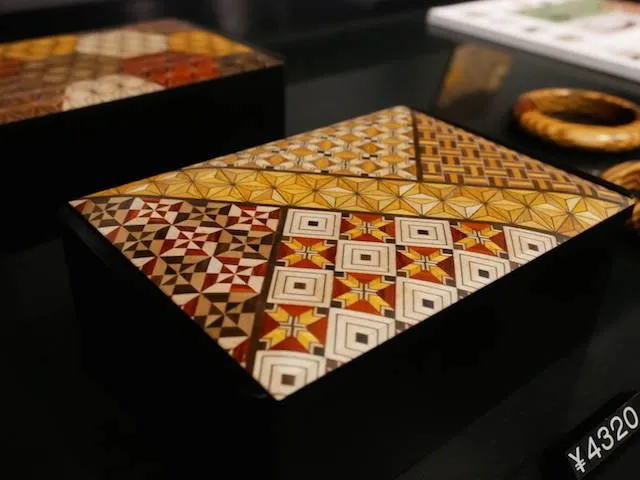
Interviewer: Which work did you find joy in making most recently?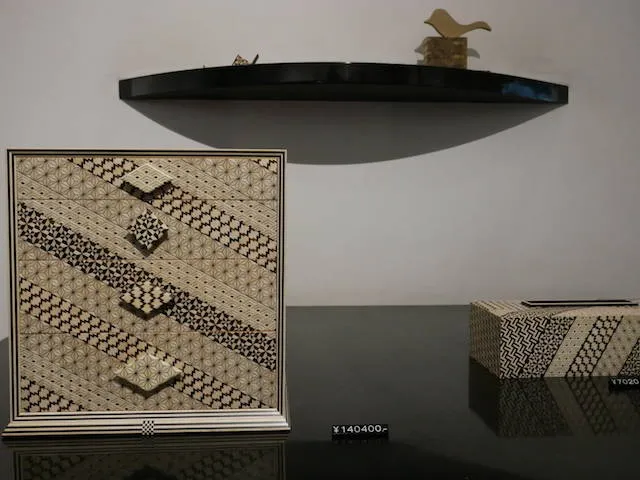 Kiyokatsu Tsuyuki: The first piece of work that comes to mind is this one. All of Hakone Yosegi-Zaiku is created using the natural colors of different trees, and no dye or paint is ever used to create color. This one is a mix of white and brownish-black timber. The white part is Mizuki, a type of wood used to make Kokeshi dolls in Japan. The black part is Jindai or trees that were buried underground but did not decompose. Every Jindai’s color is different and I use a wide variety but this brownish black timber is Katsura bogwood. Even the smallest details such as the outlines of the patterns are made with timber.
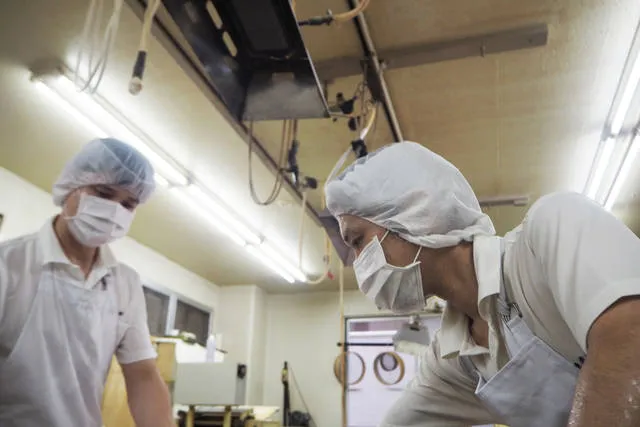 “If you cut the tree horizontally, the outer layer is white-ish, and the middle part is reddish. In Yosegi-Zaiku, we usually only use the red parts, but I wanted to try using the white outer layers too, so lately I’ve been using them in my work too. Usually, the white outer layer is thrown out.”
Demonstration of How Hakone Yosegi-Zaiku is Made
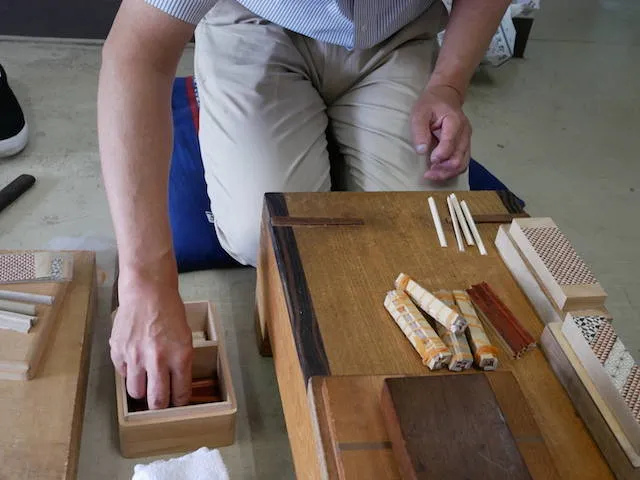
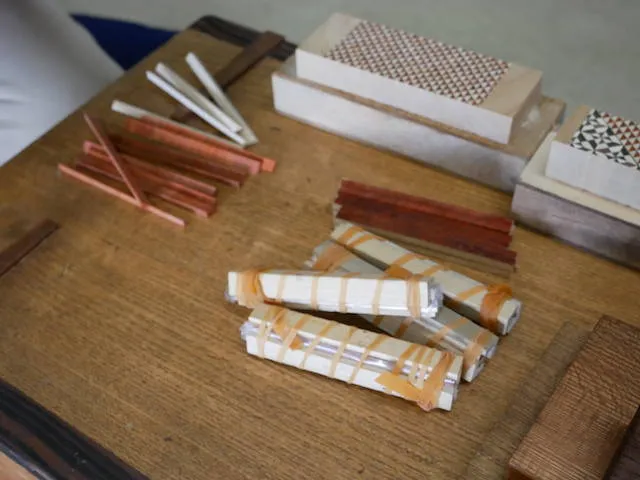 I will show you the basic steps of how the Hakone Yosegi-Zaiku is made. I will be mixing two types of timber- one is Mizuki (white), and the other is Paddock wood (red) imported from Africa.
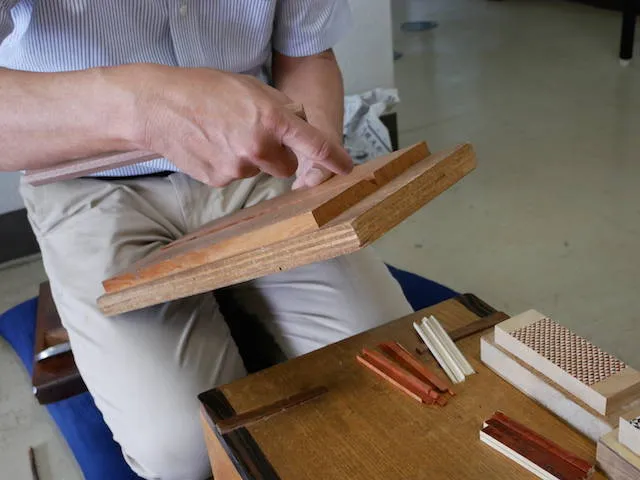 “The wood strips are about 4 mm in width, and using this plane, we make them into long triangular wood strips one by one. If this were done by a machine, the size of the wooden strips would not be the same.”
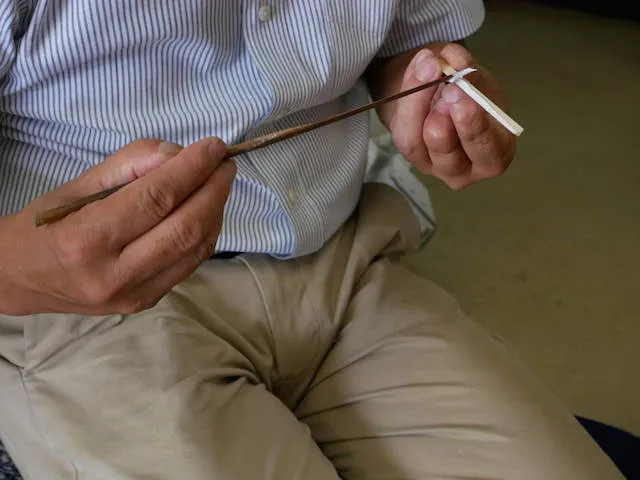 “Then we put plenty of woodworking glue on each wood strip and then glue the four white wood strips and the four red wood strips together. The wood soaks up a lot of glue so we use plenty. We use woodworking glue now but back in the day, they used to use adhesive made with skin and bones of animals. We form a block like this, and we make tens and hundreds of these to create a geometric mosaic pattern. “
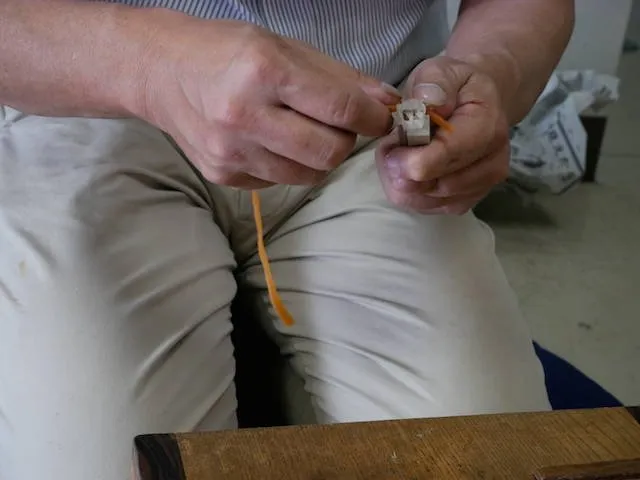 “Then we wrap up the block in plastic and put pressure on it by using other wood strips to form an “L” shape around the block, then tie everything together with a rubber band or a string. We leave it for a day to dry.”
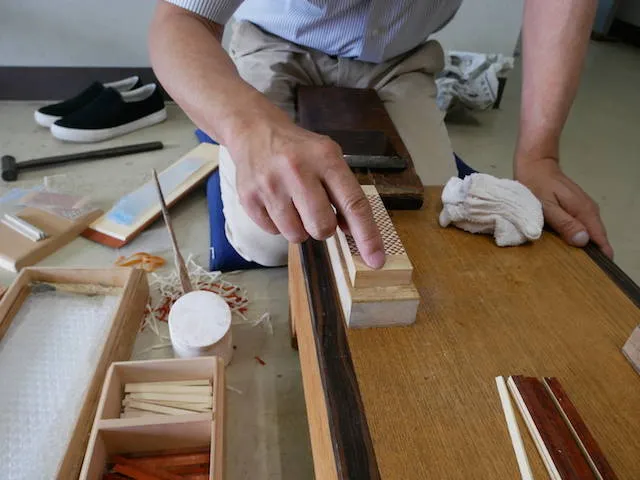 “After making 16 blocks, the pieces look like this. Then using a large plane, we shave them into thin wooden sheets.”
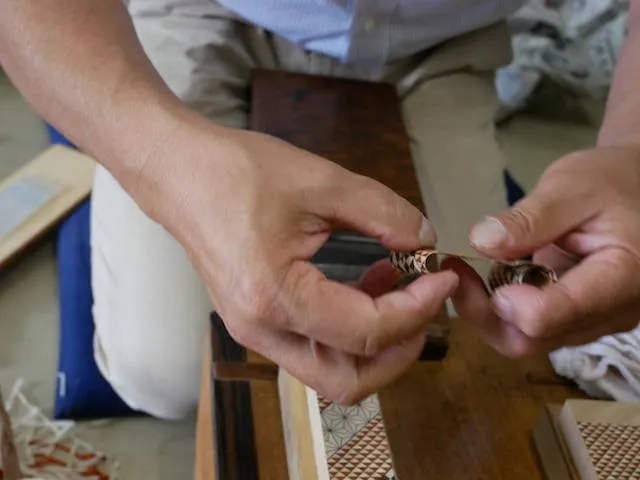 “These paper-thin sheets are then pasted onto wooden objects such as boxes, furniture, and accessories. We make much bigger thin sheets in our woodworking plant, and our biggest plane is about 60 cm wide. That is as big as it gets because anything bigger will be difficult to paste.”
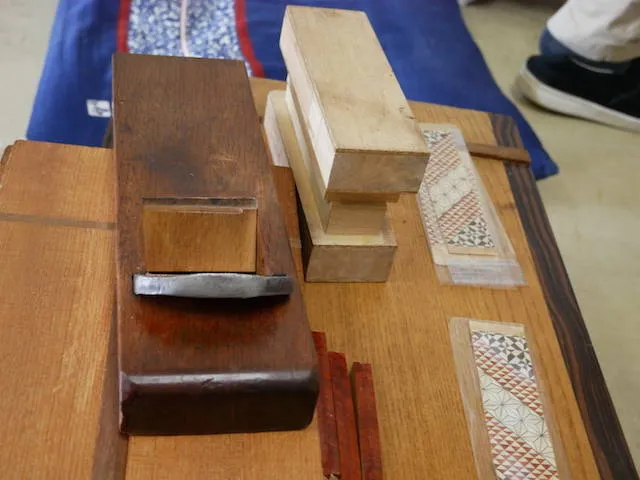 “These thin sheets become great bookmarks too!”Interviewer: Is this the basic way Yosegi-Zaiku is made?
Kiyokatsu Tsuyuki: There are mainly two ways. One way is how I showed you, shaving the blocks into thin wood sheets and then gluing them onto objects. The other way is where the wood is not cut into thin sheets but used as blocks instead. For example, this can be used to make a drawer pull. 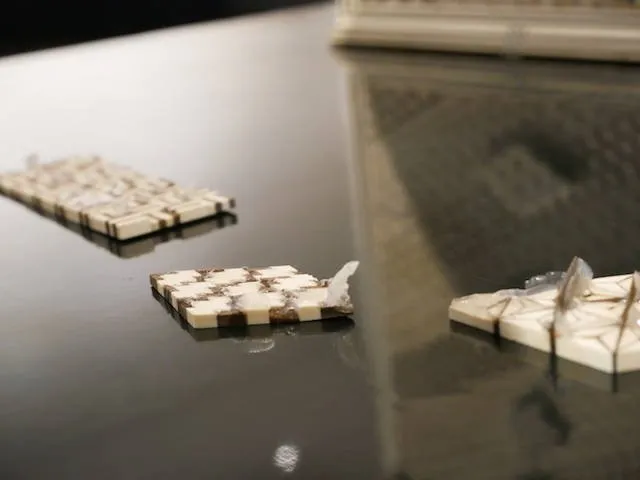 “The back of a drawer pull looks like this.”I’ve learned that there is marquetry all over the world. Some of these places include Spain, the Middle East and the oldest can be found in Egypt inside the pyramids. In other countries they use metal and bones too so it’s rare that we only use wood, and shaving them into thin sheets is also rare too. I believe the creator thought this was the best, most cost-efficient technique for mass production.
The Exciting Future of Hakone Yosegi-Zaiku
 Interviewer: What kind of projects have you been involved in recently?
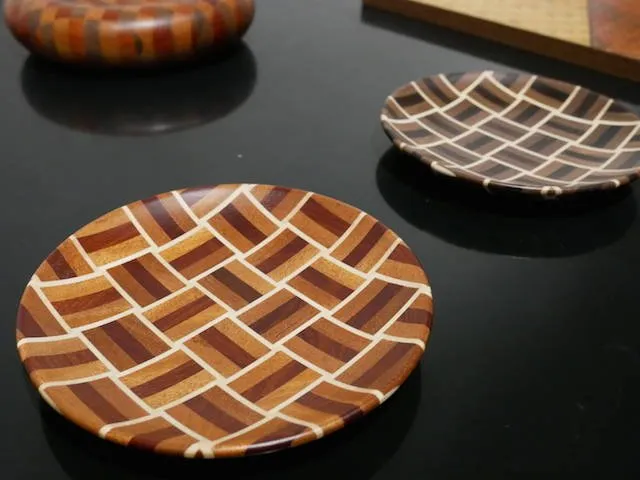
Kiyokatsu Tsuyuki: We collaborated with a major Ryokan or traditional Japanese inn in the area, and there they serve food using our plates, and in the summer serve shaved ice with our trays. They even made a room full of Hakone Yosegi-Zaiku. Customers show more interest in our craft after staying with them, and some of them come over to check out the items we have for sale.
I believe customers purchase traditional crafts when they learn more about the story and history behind it, so we try to make opportunities to demonstrate, talk and show people our story.
Interviewer: With the traditional crafts industry shrinking in size, how do you feel about the future of Hakone Yosegi-Zaiku?
Kiyokatsu Tsuyuki: With Hakone Yosegi-Zaiku, we are lucky that we have a group of 6 young talented Yosegi-Zaiku craftsmen called, “Zokibayashi” which my son is a part of. At one point a lot of media were interested in them because in many cases, there aren’t a lot of young people involved in making traditional crafts. But with Hakone Yosegi-Zaiku, there are these six young men, most of who are already skilled enough and working independently or will be running their family business in the future. Each of them has a style of their own. When the Ministry of Foreign Affairs wants to have someone do Yosegi-Zaiku demonstrations in foreign countries, one of them gets to travel for the demonstration. My son has been to about three countries too. Looking back at history, wooden crafts in this area have constantly been evolving in terms of design, and in terms of what kind of products we offer. I am hoping that the younger generation will continue to evolve the art, and perhaps turn it into something completely new.
Information
 Yosegi Gallery Tsuyuki
Access: Ride the JR Tokaido line from Shinagawa station for 1 hour and 20 minutes and get off at Hayakawa station. It is a five minute walk from the station.
Address: 2-2-15 Hayakawa, Odawara city, Kanagawa Prefecture
Open Hours: 9 AM to 5 PM *closed on Sundays, national holidays and second Saturdays