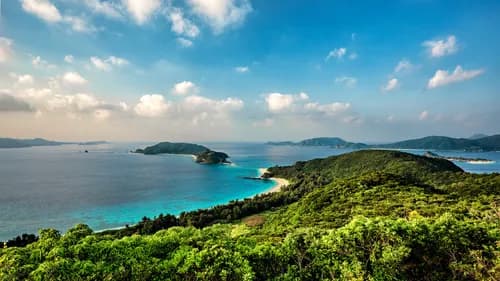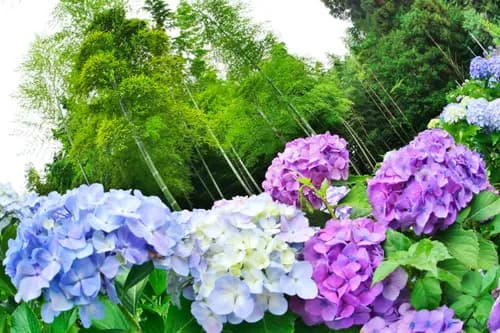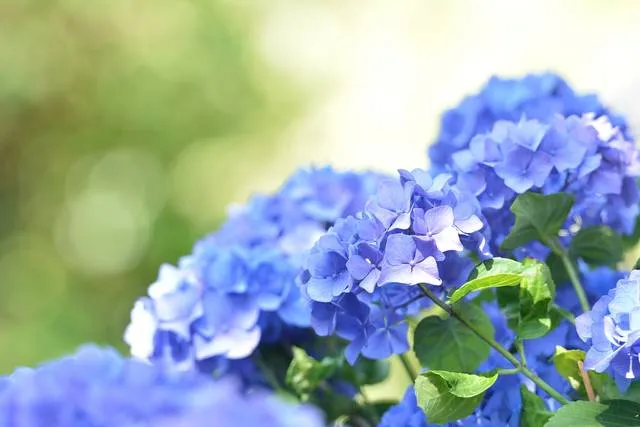
Visit Asuwayama Park, Fukui Prefecture during rainy or tsuyu season to check out the beautiful hydrangeas in full bloom! Use your five senses as you walk up the gentle slope of Mount Asuwa. Take a deep breath of fresh air and appreciate the thousands of beautiful, blue and purple hydrangeas blooming everywhere. Take your mind off your busy life and enjoy hydrangeas at one of the most beautiful hydrangea-viewing spots in Japan.
Rainy Season or Tsuyu has its benefits!
Japan has four distinct seasons. In winter, snow falls in the northern part of Japan and along the Japanese Sea, covering Japan in a white blanket of snow. In spring, cherry blossoms bloom across the country. In the summer, Japan is sunny and humid. In autumn you can see beautiful autumn foliage across the country. Other than these four seasons, there is a period that we call rainy season or tsuyu that usually starts in mid-June and lasts for a month. Tsuyu, although wet and muggy, is the best season to enjoy the beguiling hydrangeas. Japanese people love to go see these flowers in season, and hydrangeas are special flowers that can only be seen during tsuyu. And why not look at them at one of the best locations in the country? They look so beautiful in the rain!
Background information on Hydrangeas and Fukui Prefecture
Big, round and beautifully colored, hydrangeas stand out in gloomy and rainy weather. “Hydrangea” originally comes from two Latin words combined, “hydro (water) and “angeion” (pitcher). The botanist that named this flower thought it resembled an ancient water pitcher. It’s an appropriate name, considering hydrangeas bloom during tsuyu in Japan, and because they require a lot of water to bloom.
Since Japan’s soil tends to be acidic, the colors of hydrangeas are
usually purple, blue, and sometimes pink. However, the colors of hydrangeas are never red, as that usually indicates an area with alkaline soil. It’s hard to find someone who doesn’t know what a “hydrangea” is in Japan, they're popular and you can easily spot them. Throughout Japan, hydrangeas are planted at local parks or in someone’s backyard, making them very common. But the beauty of the flower is boundless when you see many of them together at once. Take a trip to see the thousands of hydrangea shrubs together!
One of the best locations to visit is Asuwayama, Fukui Prefecture. Fukui city, the capital of Fukui prefecture, has recreated historical sites from the time it was an old castle town. This makes Fukui city a prime tourist spot to visit, due to the interesting clash between old and new architecture. It’s a quiet, scenic area with fresh seafood, clean water, and great Fukui sake- a perfect escape from the city! Try hiking up the gentle slopes of Asuwayama Park (Mount Asuwa) to enjoy a view of the city. At the park, you can visit the Asuwa Shrine, the shrine that enshrines the 6th century Emperor Keitai. It also includes a small zoo, the Fukui Prefectural Museum of Natural History, a few temples, and they recently made a café; “Asuwayama Deck”, which is a popular destination among locals. If you go during tsuyu season, your stroll will be double the fun. You’ll enjoy the many blue, purple, and sometimes pink hydrangea bushes everywhere on the mountain.
Asuwayama hydrangeas
In June, Asuwayama Park brightens up with 15,000 beautiful blue and purple hydrangeas all over the mountain. On the foot of the hill, there is a “hydrangea path” named after the 6,000 hydrangeas that were planted along the road. There is a reason why there are so many hydrangeas on this mountain. After taking a survey from Fukui residents, Fukui city made hydrangeas their symbol flower and planted them on the mountain in 1952. It was in celebration of their 90th anniversary as a city.
Asuwayama is the mountain that represents Fukui city, and their objective was to make the city even more appealing to residents and tourists. Well, it worked, because now it is a popular destination for hydrangea-viewing. Listen to the raindrops on your umbrella, as you take a slow walk along the gentle slope of the mountain. Breathe in the refreshing Asuwayama air and appreciate the beautiful hydrangeas that are blooming everywhere. Listen to the birds chirping in the background and be enchanted by the beautiful hydrangeas blooming in front of you. Take note that whilst you are there, you can also enjoy Fukui’s biggest attractions: Eiheiji temple and the Fukui Prefectural Dinosaur Museum. The Eiheiji temple is a large Zen training temple that consists of over 70 buildings and structures, all connected with walkways. Since it is a major training temple, some important buildings can only be viewed from the outside- such as the Sodo (monk’s quarters) where the Buddhist monks eat, sleep and meditate. It’s a 30 minute bus ride from Fukui station. The Fukui Prefectural Dinosaur Museum is considered one of the top Dinosaur museums in the world. More than 40 dinosaur skeletons are on display. It’s about a 2-hour trip from Fukui station.
How to visit?
A 3hr 30 min train-ride from Tokyo. Take the JR Hokuriku Shinkansen from Tokyo station to Kanazawa station (2hr 40 min), then transfer to the Express Thunderbird and get off at Fukui station (about 50 min).Address: 111 Asuwakamicho Fukui city, Fukui prefecture (Asuwayama Deck)
Tel: +81-776-36-3733
Reference list
https://www.city.fukui.lg.jp/fukuisi/prezen/symbol/city_flower.html
https://www.japan.travel/en/spot/1391/