Kinashi and Kokubunji areas, located in Kagawa Prefecture in Shikoku, accounts for 80% of the pine tree Bonsai in Japan. Bonsai is a kind of Japanese traditional art form, which represents a miniaturized natural environment and the world of Zen Buddhism through a small tree. As the top Bonsai spot in Japan, Kinashi-cho holds a Bonsai festival every October. Kagawa Prefecture is also very famous for its local food “Sanuki Udon”, and some beautiful islands around the Seto Inland Sea.
Summary
Kinashi and Kokubunji areas, located in Kagawa Prefecture in Shikoku, accounts for 80% of the pine tree Bonsai in Japan. Bonsai is a kind of Japanese traditional art form, which represents a miniaturized natural environment and the world of Zen Buddhism through a small tree. As the top Bonsai spot in Japan, Kinashi-cho holds a Bonsai festival every October. Kagawa Prefecture is also very famous for its local food “Sanuki Udon”, and some beautiful islands around the Seto Inland Sea.
Bonsai – the beauty of miniaturized nature
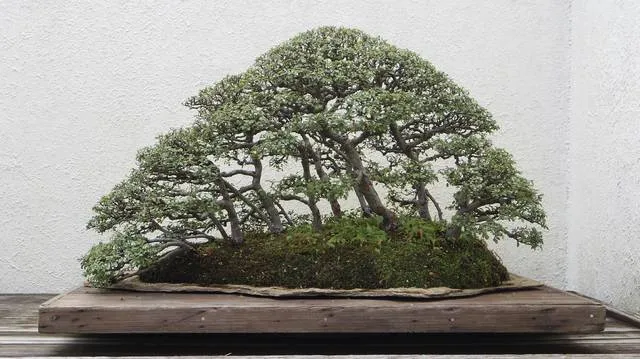
Bonsai is a dwarfed tree planted in a pot. The word Bonsai literally means “planted in a pot”. Bonsai trees are not genetically small, but it’s created by carefully remodeling with the techniques like pinching buds and wiring branches. With those techniques, any plant species with a woody trunk can grow in a container to create a beautiful Bonsai world. It’s said that this practice was derived from ancient China, and has been in Japan for over a thousand years. The fundamental purpose of growing Bonsai is to create a representation of nature in the form of a small tree and appreciate its beauty. It’s a kind of Japanese traditional art form, and shows a symbolic idea of Zen Buddhism.
World-famous pine tree Bonsai from Kagawa
Any tree can become Bonsai, but the most common plant is a pine tree. Kinashi and Kokubunji areas, located in the western part of Takamatsu City in Kagawa, are famous for producing the most pine tree Bonsai in Japan. It accounts for 80 percent of the national share.
Kagawa Prefecture’s pine trees have a good reputation not only for their beautiful shapes, but also their durability. Being cultivated in the well-drained and sandy land of Kagawa Prefecture, the pine tree’s roots are very sturdy and hard to damage. Recently, Bonsai has been growing in popularity as part of Japanese culture in other countries. Being exported to western and Asian countries, Kagawa’s Bonsai are now well-known not only domestically but also internationally.
Kagawa Prefecture’s pine trees have a good reputation not only for their beautiful shapes, but also their durability. Being cultivated in the well-drained and sandy land of Kagawa Prefecture, the pine tree’s roots are very sturdy and hard to damage. Recently, Bonsai has been growing in popularity as part of Japanese culture in other countries. Being exported to western and Asian countries, Kagawa’s Bonsai are now well-known not only domestically but also internationally.
Stunning view of Bonsai exhibition
In this Bonsai town, Kinashi area, the Festival of Bonsai is held every autumn around mid or late October. You’ll be able to see more than 500 varieties of 20,000 Bonsai exhibited. Surprisingly, some of the oldest Bonsai trees are from over 300 years ago! The price range can also vary greatly; the minimum cost of one can be about 300 yen, on the other hand, the most expensive ones’ can go up to 20 million yen. Prices are set according to the age of the Bonsai, quality of the tree itself, as well as the pot, and the artist. Even if you don’t purchase one at this festival, you can enjoy the alleys full of amazing Bonsai during the exhibition, Bonsai auction or Bonsai check-ups taking place, Bonsai trial lessons or even tasting Kagawa Prefecture’s soul food “udon” at a pop-up shop.
Attractive spots for Bonsai fans
Another great place for Bonsai fans is Bonsai Jinja (Bonsai Shrine) located in Kokubunji-cho right next to the Kinashi area. It was built to pray for bringing happiness to Bonsai towns, Kinashi and Kokubunji-cho. This is the only shrine for praying for Bonsai in Japan, which makes it a quite unique place.
In Takamatsu City, which is only 10 minutes away from the Kinashi and Kokubunji area by train, there is a fantastic park where you can see one thousand of Kagawa’s pine trees. Named Kuribayashi Park, it has a 200 year of history of being used as a villa by the Matsudaira Family, the feudal lord of the Takamatsu domain during the Edo Period. It’s also designated as a place of special scenic beauty. Kuribayashi Park has been a popular place for tourists to look over the fantastic view of the one thousand pine trees, with the Shiun Mountains in the west. Out of the thousands of trees in the area, two spots, called “Hako-matsu” and “Byobu-matsu”, are particularly stunning. At these two spots, you can see the very old pine trees configuring the shape of a spacious box (Hako-matsu meaning a box of pine trees) and a green wall (Byobu-matsu meaning a folding screen of pine trees). The pine trees have been cared for over 300 years with Kagawa’s great Bonsai techniques. It’s said to be the top area to study Bonsai.
In Takamatsu City, which is only 10 minutes away from the Kinashi and Kokubunji area by train, there is a fantastic park where you can see one thousand of Kagawa’s pine trees. Named Kuribayashi Park, it has a 200 year of history of being used as a villa by the Matsudaira Family, the feudal lord of the Takamatsu domain during the Edo Period. It’s also designated as a place of special scenic beauty. Kuribayashi Park has been a popular place for tourists to look over the fantastic view of the one thousand pine trees, with the Shiun Mountains in the west. Out of the thousands of trees in the area, two spots, called “Hako-matsu” and “Byobu-matsu”, are particularly stunning. At these two spots, you can see the very old pine trees configuring the shape of a spacious box (Hako-matsu meaning a box of pine trees) and a green wall (Byobu-matsu meaning a folding screen of pine trees). The pine trees have been cared for over 300 years with Kagawa’s great Bonsai techniques. It’s said to be the top area to study Bonsai.
The udon kingdom Kagawa
Besides Bonsai, another famous attraction in Kagawa is their soul food “udon” or Japanese traditional wheat noodles. Once you get to Kagawa Prefecture, you’ll find udon shops almost everywhere, so much so that Kagawa Prefecture is often called “Udon-Ken” (Udon Prefecture) instead. The local udon in Kagawa is especially called “Sanuki udon”. Compared to the other kinds of udon from different areas, Sanuki udon noodles have a very chewy texture. It’s usually served with a simple soup made from dried sardine bouillon.
Although you can find Sanuki udon shops in Tokyo or any other big city in Japan, the udon experience in Kagawa Prefecture will be pretty special. There are approximately 800 udon noodle shops in Kagawa, and some of them are so popular that there’s a long queue in front of the shop all the time. If you are not sure which shops to stop by, you can hire a local udon expert, like a “udon taxi” providing a personalised tour to some recommended udon shops. There’s also a special bus service to take you around the various famous udon shops. Sanuki udon shops are also easy on your wallet. If you have 300 yen, you can taste a bowl of amazing noodles to fill you up!
Although you can find Sanuki udon shops in Tokyo or any other big city in Japan, the udon experience in Kagawa Prefecture will be pretty special. There are approximately 800 udon noodle shops in Kagawa, and some of them are so popular that there’s a long queue in front of the shop all the time. If you are not sure which shops to stop by, you can hire a local udon expert, like a “udon taxi” providing a personalised tour to some recommended udon shops. There’s also a special bus service to take you around the various famous udon shops. Sanuki udon shops are also easy on your wallet. If you have 300 yen, you can taste a bowl of amazing noodles to fill you up!
Islands and Art
Facing the Seto Inland Sea, Kagawa Prefecture in Shikoku has some great islands around which are accessible by ferry from Takamatsu Port. Nao-shima, Te-shima, Megi-jima, Ogi-jima and O-shima are the popular islands to head to! This area is known for its moderate climate and having low rainfall.
If you want to enjoy the unique combination of the slow island atmosphere and modern art, you should definitely visit Nao-shima. About one hour by ferry from Takamatsu Port, this island is known for its modern art museums. Chichu Art Museum and Benesse museums were designed by Japanese architect Ando Tadao, and many installations and sculptures randomly appeared on the island. You can also relax on the beautiful sandy beaches.
If you want to enjoy the unique combination of the slow island atmosphere and modern art, you should definitely visit Nao-shima. About one hour by ferry from Takamatsu Port, this island is known for its modern art museums. Chichu Art Museum and Benesse museums were designed by Japanese architect Ando Tadao, and many installations and sculptures randomly appeared on the island. You can also relax on the beautiful sandy beaches.
How to visit?
It’s about 75 minutes by plane from Tokyo to Kagawa Prefecture. The bus from Takamatsu Airport to Takamatsu Station is about 45 minutes. Take the JR Yosan Line from Takamatsu Station and get off at Kinashi Station, which takes only 7 minutes. The Kinashi Bonsai Cultivation Center is a 15 minute walk from there.
Address: Kinashi Bonsai Cultivation Center 333-1 Kinashi-cho Yamaguchi, Takamatsu City, Kagawa Prefecture 761-8025
Tel: +81-87-882-4091
Address: Kinashi Bonsai Cultivation Center 333-1 Kinashi-cho Yamaguchi, Takamatsu City, Kagawa Prefecture 761-8025
Tel: +81-87-882-4091