content: I talked with ROBE JAPONICA’s designer Ueoka and director Oyama about their brand which has developed a new style of Japanese clothes. How does this brand, pushing out pop casual Japanese clothing from Harajuku, think about the charm of Japan and its distinctive clothing?
Summary
I talked with ROBE JAPONICA’s designer Ueoka and director Oyama about their brand which has developed a new style of Japanese clothes. How does this brand, pushing out pop casual Japanese clothing from Harajuku, think about the charm of Japan and its distinctive clothing?
ROBE JAPONICA Interview
To start things off, could you tell us a bit about how you think about Japan’s charm and how that affects your work on the ROBE JAPONICA brand?  Oyama: Just recently when I was guiding a tour, a question popped into my mind. I wondered just what it was about Japan that excited foreign tourists? What was it that made them feel fascinated?
One answer that I thought of is that Japan’s charm comes from its stance of preserving things that must be preserved without being overly conservative.
As Japanese people, while we protect the roots of our culture and our traditions, we also bring in foreign culture by adapting it to our tastes. We transform it. We take in innovation and change it. Also, with recent things like new technology or anime, we cross over these new things and make another, newer thing.
- Preserve
- Adopt and adapt
- Invent
I thought that perhaps it’s these three things that are Japan’s charm.
When I was guiding foreign tourists the other day, it was cherry-blossom season. Among the cherry trees, there is a castle. At that castle, Japan’s history and tradition are still alive. This is something that’s being preserved.
On the other hand, the Japanese curry rice we ate for lunch was very different from the Indian original. It’s been adapted to Japanese style. That sort of thing lets you glimpse “Japaneseness.”
However, the castle exhibits used animation from a famous anime studio and projection mapping, making the application of technology part of this Japaneseness.
I felt that perhaps it’s having these different facets that constitute Japan’s charm.Ueoka: Also, I think that another point of view on Japan’s charm is that it has a strong sense of the four seasons.
Japan pursues the beauty of each season in various handicrafts. Season is important in food, and we even change the plates according to the season. We also change the furnishing of rooms. I think that Japaneseness is feeling the beauty of the four seasons and their change.
And it’s the same with kimono and other clothing. Traditional Japanese clothing reflects this sense Japanese people have of seasonal aesthetics.
For example, just before cherry-blossom season, around March, wearing Japanese clothing with a cherry blossom pattern expresses a sense of waiting eagerly for cherry blossoms. The Japanese phrase “the remains of sweetfish” expresses the feeling of treasuring the remains of a bygone event. This way of thinking is praised as sophisticated in Japan.
When looking at these sorts of customs, I feel that perhaps more than anyone else in the world Japanese people know the beauty of the four seasons.
Q: What was the catalyst or reason you decided to make clothing that combines Japanese clothes and pop?Oyama: Actually, I wrote down the concept.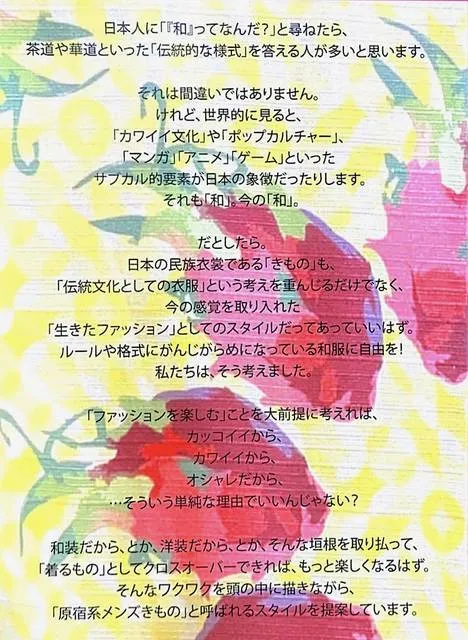
Concept statement:If so, we shouldn’t just think of kimono, Japan’s native clothing, as mainly the clothing of traditional culture. We need to integrate a sense of the now into it. It must be a style of living fashion. We must liberate Japanese traditional clothing from the rules and formalities that weigh it down! That’s what I thought.
What is “Japan” to Japanese people? I think when asked, most Japanese people would answer with traditional forms like tea ceremony or flower arranging.
That’s not wrong. But when you look at it globally, it seems like the image of Japan comes from subcultural elements like cuteness culture (kawaii), pop culture, manga, anime, or video games. That’s also “Japan.” The Japan of now.
If we take it as given that fashion is something to be enjoyed, isn’t the simple fact that something is cool, cute, or stylish enough in itself?
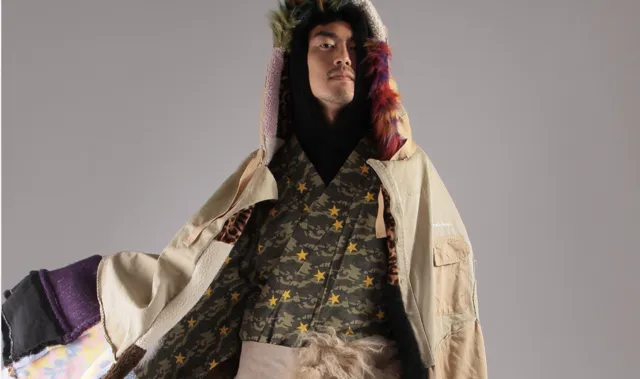
If we can pull down the walls that say, “oh, because this is Japanese clothing,” or “oh, because this is Western clothing”, if we can consider them just as “things to wear” and cross them over, it will be more fun. With that excitement in my mind, I drew out a proposed style called “Harajuku-Style Men’s Kimono.”
It was originally begun as a men’s brand, but what’s called men’s kimono are usually all boring colors like navy blue and light brown. It’s not very enjoyable as fashion.
To turn that sort of thing into a kimono, or perhaps a yukata, that can be more completely enjoyed, that’s where we started from in making the ROBE JAPONICA brand.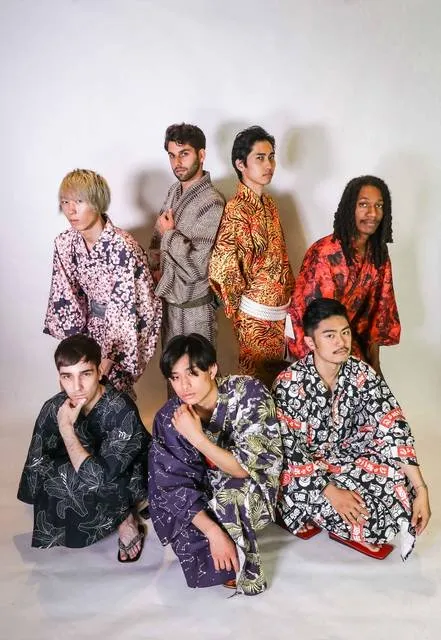 However, we don’t want to destroy the form of the kimono. We preserve the Japanese traditional form while bringing in foreign elements of design, material, and pattern. I think it’s close to the second idea of the three I mentioned before: “Adopt and adapt.”Q: So it’s not based on intention to rearrange or make something new. It’s about using something we already have while changing the style or how it feels when you wear it. Did you have a strong sense that you want to make a kimono that you can throw on lightly instead of stiffly and formally?Oyama: That’s true. No matter how you slice it, kimono are something that Japanese people unfortunately only wear formally.
We try to change that. Unless we are talking about super formal occasions such as weddings or funerals, it should be fine to wear kimono freely according to your taste.
We often have foreign people in our shop, and I think it would be best if they could put kimono on over their street clothes, or tie them with a rope instead of the traditional obi belt. Our stance is that people should wear them as they want to.Q: So you provide kimono that can be approached freely according to people’s different sensibilities and styles?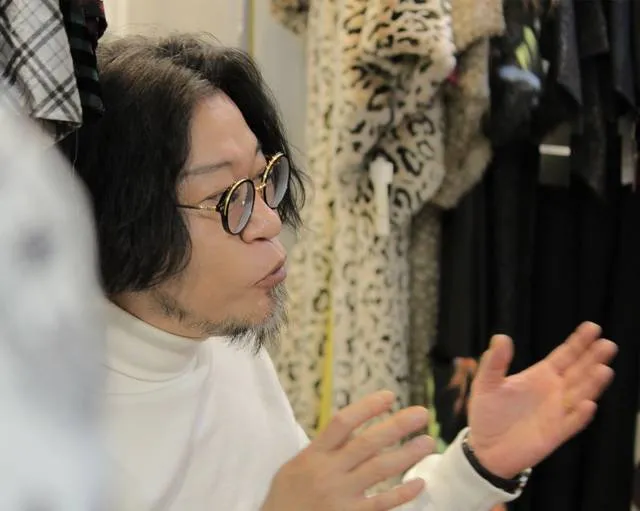 Ueoka: That’s right. When speaking about Japanese clothing, I think that the people wearing the kimono should decide how to interpret them, without having our values pushed on them.
However, it is important to understand that there are times when kimono do need to be understood in keeping with their status as ethnic clothing. Similar to the black suit of Western clothing, there are Japanese kimono that are designed to be worn properly. That has an importance of its own and it is understandable that there are rules for them.
At the same time, there are casual lines of Western clothing like t-shirts and jeans. Why not have casual kimono that aren’t bound by rules and formality? That’s what I was thinking when we started this brand.
It’s said that the number of people that wear kimono today is declining. But if we make an entry point where people can say, “Oh, kimono are cool, stylish, fun,” then the number of people who feel comfortable with kimono will increase. Then some day, that could lead to them saying, “I want to buy a proper kimono, too.”I sometimes wonder, just what is tradition in the first place? “Oh, it means that nothing changes.” No, that’s just transmission. It’s not tradition. Even if the trunk of the tree stays the same, the leaves change. The leaves change from year to year. I think that’s what tradition is.
For example, there’s a Japanese sweet shop in Kyoto that has been in business for 300 years and says they have not changed their traditional production methods. But the ingredients themselves, like sugar, flour, or sweet beans, have changed over the last 300 years. Even if the way you make it doesn’t change, the ingredients and flavor change bit by bit as the years go by. That’s what I think tradition is.
And that’s how I think kimono should be. Right now in Japan, we have Japanese-style pop culture. Shouldn’t we apply those pop elements to traditional clothing? Shouldn’t somebody be creating kimono for the current age? That’s what I thought when I started this brand.
Still, when we take this sort of stance, we still can’t ignore traditional crafts. We collaborate with a Kiryu textile manufacturer, a traditional black dye maker for yukata, and a Kyoto Nishijin fabric maker for the obi. We bring in modern designs, but we use traditional crafting methods.Q: And in that sense, there’s great meaning in setting up your shop in Harajuku, isn’t there?Oyama: Harajuku is where Japan’s fashion trends are set. It’s a place where many fashions mix together. It was partly because of our desire for people to wear kimono freely that we chose to open our shop in Harajuku.Q: Out of all of the types of Japanese clothing, why did you choose kimono and yukata?
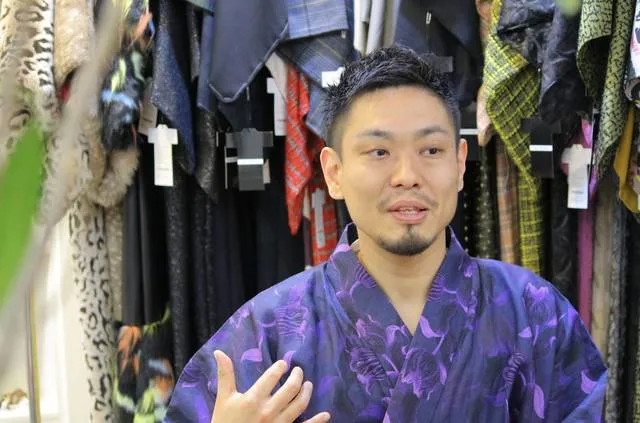 Oyama: Most Japanese clothing has this lingering sense of being attached to work, like a costume or uniform. That’s why ordinary people are not used to wearing it without having a professional reason for doing so. However, there are still people that wear kimono and yukata today. It’s a type of Japanese clothing that we haven’t lost the chance to wear, something that blends into everyday life. Yukata in particular are the closest to everyday life. People wear them to fireworks displays or on traditional Yakatabune party boats. That’s why we chose them.
This is just my personal opinion, but even when compared to other Asian countries, Japan still has the image of a country where traditional clothing is close to everyday life. It’s a little piece of culture we preserve, but I wonder if we can’t reinvigorate it even more.
Right now everyone is excited about inbound tourism, so I feel this is a good time to take a moment and reconsider what Japaneseness means. There’s a movement to rediscover the charm of Japan from the point of view of foreign people. I would be happy if ROBE JAPONICA could be a point of entry into the world of kimono that is part of this Japaneseness.Q: How would you like people to enjoy kimono as fashion?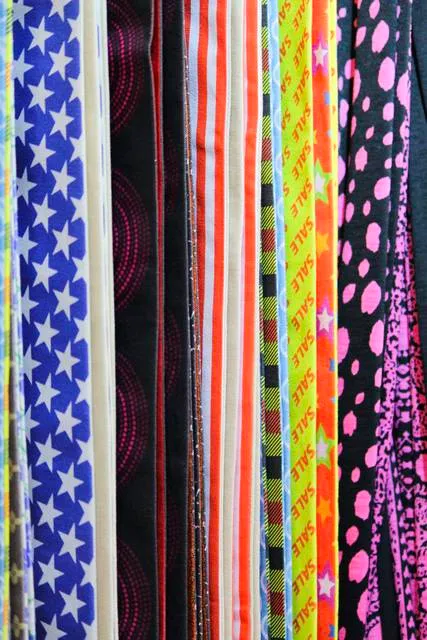 Oyama: When recommending a kimono, it’s better to ask what it will be used for or who it is for, instead of just recommending one specific piece. That’s not unlike Western clothing. Where will it be worn? How do you want to wear it? When you ask this, people might say “I’ll wear it when I get out of the bath, so cotton is good,” or “My father is this tall and he prefers plain design.” Once you know what they want, you can most often introduce them to something that meets their needs. Again, we take our customer’s interpretation of what kimonos mean to them very seriously and do not force our own set of values on them.
ROBE JAPONICA only makes four or five pieces from any pattern, so it’s unlikely you’ll see someone else wearing the same design. I hope that people are able to enjoy the feeling of having a kimono no one else has as well as the design aesthetic.Ueoka: One other thing I hope people enjoy is the difference between Western clothing and Japanese clothing.
Western clothes are three-dimensional objects, made along a pattern. It’s clothing that you wear by putting your body into that pre-existing shape. In contrast, kimono are flat. They flatten out. It only turns into a three-dimensional shape when matched with your body.
Now, when you adapt the clothing to your body to form the final shape, even when you gain some weight or wear it with other clothing, there are no buttons to keep it in place. That’s why Japanese clothing supports the most wonderful feeling of flexibility.
Because your body isn’t crammed into a pre-existing form, your body can enjoy the inside of the clothing more. That’s what makes it comfortable to wear.
In that sense, I feel that the term “put on” is more appropriate than just “wear.”
I’d like everyone to get to know this flexibility and comfort of Japanese clothing that is different from Western clothing.Q: What’s the reaction from your actual customers?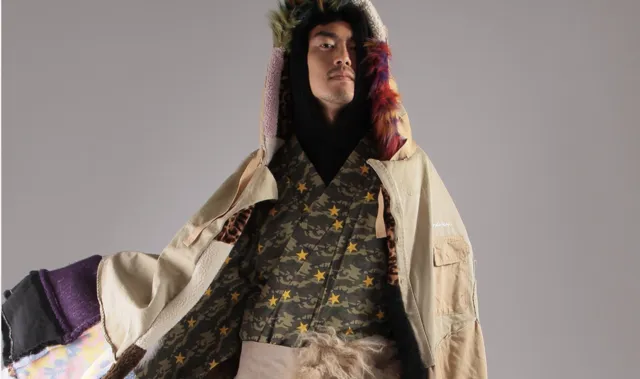 Oyama: Many say, “Wow, gorgeous!”, “Beautiful!” or “Good job!” to these unique designs. There are also people who occasionally upload pictures on Instagram linked with the name ROBE JAPONICA.
Many of our customers want to stand out a bit and are attracted by the unique design. Many of them are stage actors or DJs, or other people that have to stand in front of others because of their jobs. Previously, a famous global musician came to the shop and uploaded a picture to Instagram wearing it without an obi, like a gown.
Japanese people might think that you have to wear it with an obi. But surprisingly, foreign people wear it freely and it looks cool. In Japanese we say that we ‘fling on’ kimonos, so I think dressing well in this free manner is absolutely fine.Q: Thank you very much.