content: With rising interest in ramen, a local chef has modernized ramen for more health-conscious individuals. The result is a unique meal that is also a one-of-a-kind experience.
Summary
With the rising interest in ramen, a local chef has modernized ramen for more health-conscious individuals. The result is a unique meal that is also a one-of-a-kind experience.
Ramen Revised
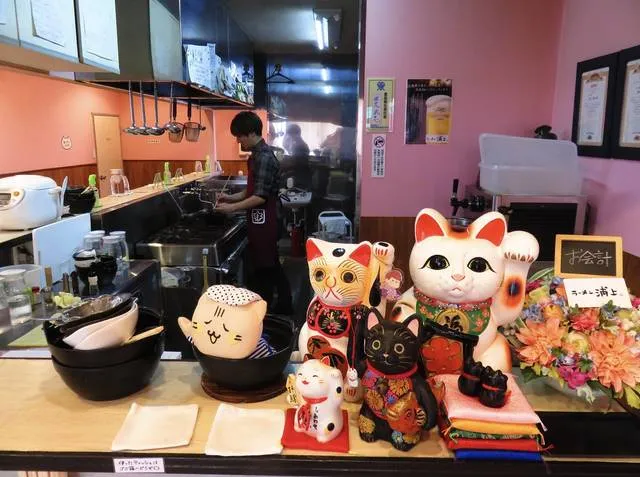
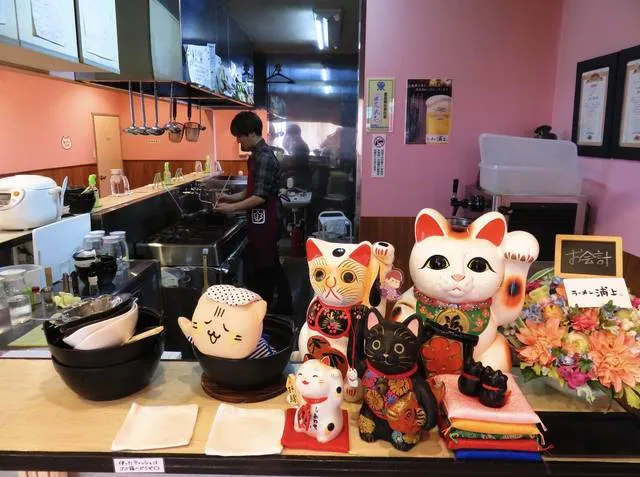
Visitors are greeted by Maneki-neko.
Sometimes, it takes youth to rethink an age-old tradition.
In the small town of Hadano, in Kanagawa prefecture, Takeshi Takyu, who goes by the name Q-chan, has done just that. After studying with a ramen master in Hiroshima, he wanted to create a version of ramen that was lighter than the traditional kind and didn’t contain so much salt. He looked to hisashi nabeyaki ramen for inspiration, an odd choice since that style of ramen is heavy on the salt and oil to accommodate men partying in Hiroshima’s entertainment district. After a night of drinking, their tastebuds have been numbed from alcohol and they are searching for ramen that is salty and flavorful.
But Q-chan discerned a web of interweaving flavors beneath the salt and oil of hisashi nabeyaki that he knew could be enhanced to make a broth that would serve his purpose.
“I wanted to show that even without lots of salt and oil, I could deliver a delicious meal.”
The Broth
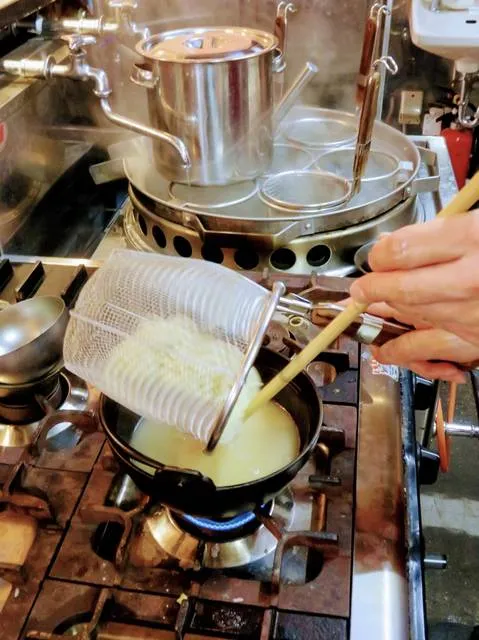
The ramen is prepared in a cast iron bowl.
It starts, of course, with the stock, which Q-chan makes by hand by slow simmering chicken and pork bones. The subtle flavors of the broth are intensified through reduction, and what little fat the broth contains is rendered, with the result that the broth is almost creamy. The result is a one-of-a-kind broth that is light on the stomach, but strong on the palate.
With the popularity of ramen growing, and many foreign visitors to Japan in search of authentic ramen shops, it would have been easy to simply stick with tradition and focus on marketing and social media to find customers. Every prefecture, indeed, seemingly every locality has its own version of ramen using the specialities of their area, so Q-chan could have used Hadano’s pure water (ranked the best in Japan) or local peanuts and vegetables as a hook to entice customers. But he didn’t want to take the easy way. Q-chan’s vision was to create a new type of ramen for an emerging market.
“A lot of people these days are very aware of their health and want to eat healthful meals. That means less salt and fat. Women, in particular, want food that is healthy and low calorie. Because ramen relies on salt and oil for much of its flavor, there was a void in the market, and I hoped to fill it.”
The Ingredients
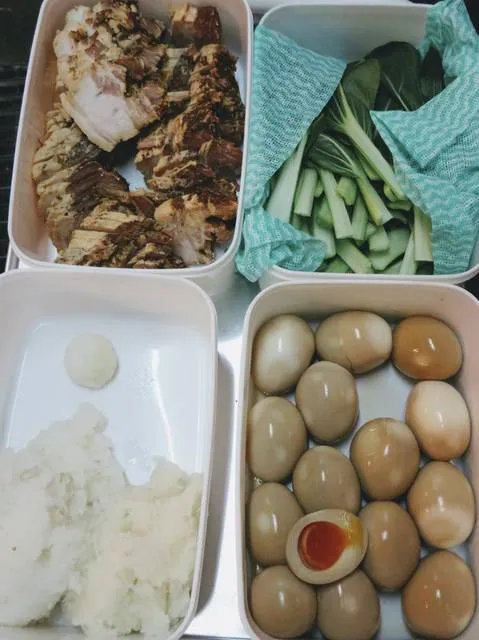
The elements of a delicious meal of ramen:handmade chashu, fresh vegetables, and freshly-boiled eggs.
If making a healthy meal is a priority, it is important to have quality ingredients. To maintain quality control, Q-chan hand makes each part of his ramen: his noodles are hand rolled and cut thin to make them easier to eat. Fresh made noodles have a texture that allows more broth to attach to them, so the broth/noodle balance is more even. The chashu, which can make or break a ramen bowl, is hand-seasoned and simmered to melt-in-your-mouth. Q-chan boils the eggs semi-hard and hand rolls the grated daikon the same way sushi chefs hand-form sushi rice. The result, a meal that may look like other bowls of ramen, but that is distinctly different.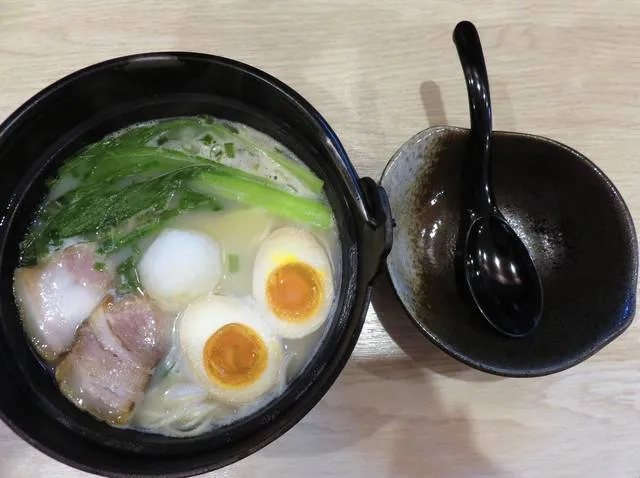
A bowl of ramen that may look like any other, but that is full of flavor and low in salt and fat.
Yet, Q-chan can’t control everything. Variations in the chicken and pork bones influence the final result, so no two bowls of ramen are exactly the same. “It’s like surfing,” he said. “All the waves are formed the same and made of the same material, but no two waves are ever exactly the same.”
Ramen for Health-Conscious Consumers
In October of 2017, Q-chan opened his signature ramen shop in Hadano, Ramen Urakami, where, ramen is not just a meal, it is an experience that is noticeable from the moment guests step in the door. It has the traditional counter that borders the kitchen, but the room is spacious and airy, clean and fresh, and with pink walls, a conscious contrast to the narrow, smoky, greasy traditional ramen restaurants.
“More women are working these days, more women are traveling, and women are particular about where they eat. They are more focused on the aesthetics and hygiene of a restaurant, so I wanted to create something that was inviting and welcoming to them. A place where they wouldn’t feel conspicuous and uncomfortable.”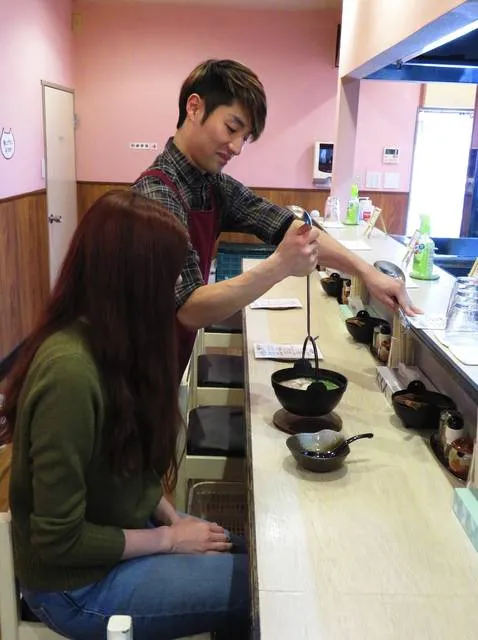
Presentation is an important part of the experience at Ramen Urakami.
Ramen that Honors the Customer
The experience continues when the ramen is served. Ramen Urakami does not use ceramic bowls. Rather, the ramen is cooked, prepared and served in an iron pot that is hand-delivered on a hook. It is placed in front of the guest with a focus and precision that is the hallmark of Japanese service. A tradition that is meant to honor the guest, pay respects to the ramen that has just been served, and allow the guest to reflect on the beauty of what has been created for them. Guests are then able to dress their ramen to taste by adding raw garlic, sesame seeds, and spice at their discretion.
Interestingly, Ramen Urakami, despite its modernization of ramen and its associated restaurants, is one of a few ramen restaurants that offers Ojiya, a traditional dish that is considered the Japanese version of risotto. Rice is cooked in the leftover ramen broth, garnished with select toppings, then again served piping hot to the guest. 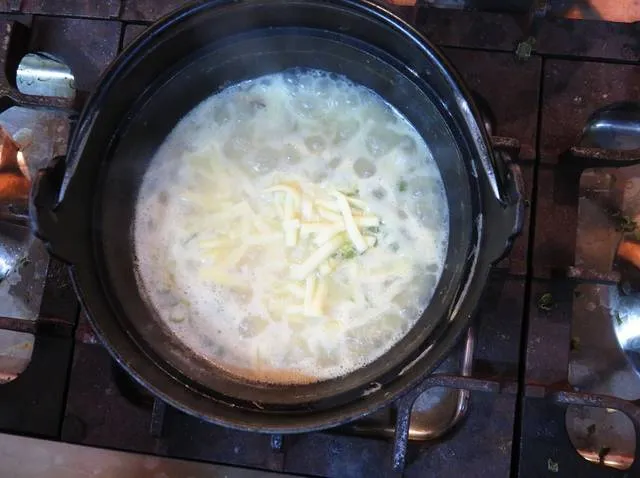
A boiling dish of Ojiya, a Japanese style of risotto made from the left over broth of a bowl of ramen.
“Tradition isn’t bad,” said Q-chan. “Sometimes it needs to be brought back, sometimes it needs to be modernized, but it is the foundation on which we build and create, the thing that inspires us. That is probably the most important lesson I learned from my teacher.”
Information
You can find more photos and information (in Japanese) on Twitter: @ramenurakami.