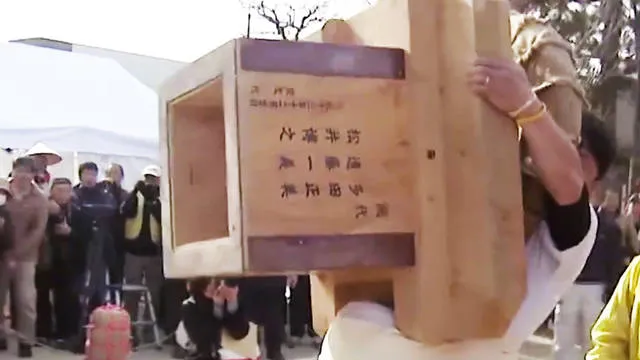
The big rice cake carrying game is held every year at the Nagaoji Temple in Kagawa prefecture on January 7th. The weight of rice cakes and pedestal is about 190kg/420pounds, and 7 men lift up the rice cake and pass it to a participant! For kids, women, and unexpected participants, they carry a 45kg/100pounds sandbag. The participants compete with walking distance.
Nagao Temple: Shikoku 88 Temple Pilgrimage
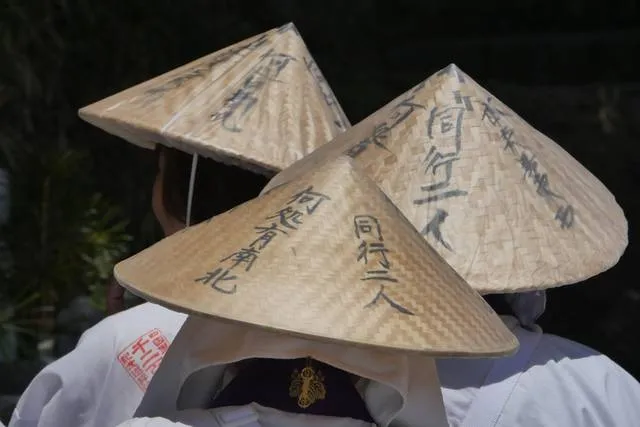
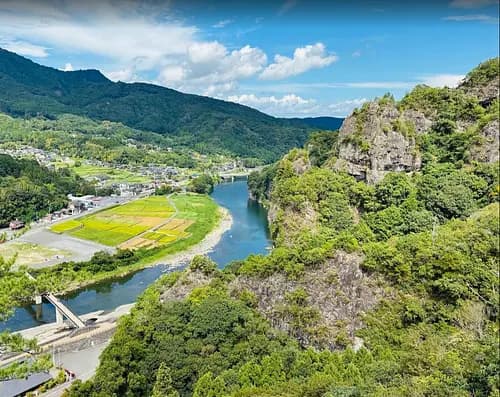
The big rice cake carrying game is held at the Nagaoji Temple in Kagawa prefecture. Kagawa is located at Shikoku Island, the smallest of the four main islands of Japan. Nagao temple is famous for being one of the temples for the Shikoku 88 Temple Pilgrimage. Every year, hundreds of thousands of pilgrims from and outside of Japan visit the 88 temples associated with the holy man Kobo Daishi, known also as Kukai. Ohenro is the Japanese word for Shikoku 88 Temple Pilgrimage and is known more than the world heritage site the Kumano Kodo in Wakayama prefecture. The route passes through the four prefectural capital cities, Tokushima city, Kochi city, Matsuyama city, and Takamatsu. Most of the route is on fairly busy main roads. Some sections are in the less populated countryside and few are on secluded mountaintops. Nagao temple is the 87th temple for the Shikoku 88 Temple Pilgrimage.
Big rice cake carrying game and Fukubai
The big rice cake carrying game, called Nagaoji Daieyo or Chikaramochi Unpan Kyogi in Japanese, is held on January 7th every year. Before the game, a monk offers a Buddhist service praying for rich harvest, homeland protection, and peace. After that, Fukubai is performed at 12 pm. Fukubai means “getting luck for the year”. At Nagao temple, the priests throw 3,000 rice cakess to the people at the temple. The rice cakes are from rice cake pounding festival held on January 2nd. People try to get as many rice cakes to get good lucks. Join the Fukubai to get free rice cakes!
After the Fukubai, the rice cake carrying game takes place. While the weight of rice cake per man changes every year, it is about 190 kg (420 lbs) per man. It’s almost weighs as much as a middle-sized bike and more than a sumo wrestler’s weight. 7 men lift up the rice cake and pass it to participants. In other rice cake carrying games, rice cakes and pedestal are usually fixed firmly by a rope or a tape, but for this specific rice cake carrying game, the participants have to hold them all together throughout the game. The scene of men putting sumo wrestler's loincloths makes the game more serious and athletic. Almost all of the male participants join the game every year.The rice cake used for the game is cut with chaff utter and is distributed to the parishioners. For kids, women, and unexpected participants, they carry a 45 kg (100 lbs) sandbag and compete. It might be challenging to communicate with them if you don’t speak Japanese, but you are more than welcomed to join the game! It’s a great opportunity for you to hang out with locals and experience Japanese new-year traditions.
After the Fukubai, the rice cake carrying game takes place. While the weight of rice cake per man changes every year, it is about 190 kg (420 lbs) per man. It’s almost weighs as much as a middle-sized bike and more than a sumo wrestler’s weight. 7 men lift up the rice cake and pass it to participants. In other rice cake carrying games, rice cakes and pedestal are usually fixed firmly by a rope or a tape, but for this specific rice cake carrying game, the participants have to hold them all together throughout the game. The scene of men putting sumo wrestler's loincloths makes the game more serious and athletic. Almost all of the male participants join the game every year.The rice cake used for the game is cut with chaff utter and is distributed to the parishioners. For kids, women, and unexpected participants, they carry a 45 kg (100 lbs) sandbag and compete. It might be challenging to communicate with them if you don’t speak Japanese, but you are more than welcomed to join the game! It’s a great opportunity for you to hang out with locals and experience Japanese new-year traditions.
What symbolizes big rice cake?
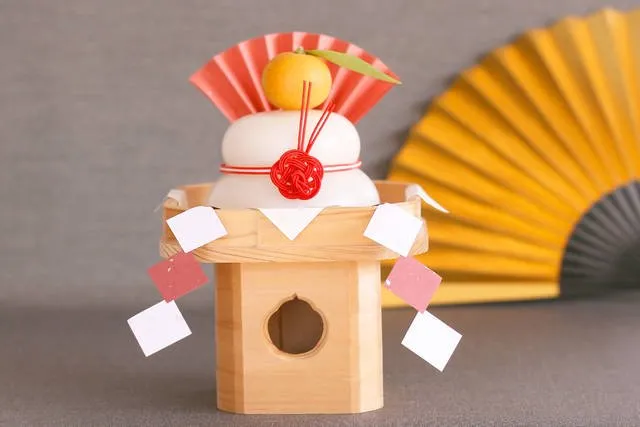
The big rice cake used in this game is called Kagami mochi. Kagami mochi means “Mirror rice cake” and can be found anywhere around the house from the end of the year until around Jan. 11th. Kagami mochi usually consists of two round mochis and a daidai, a Japanese orange with a leaf attached on top. Usually, the small rice cake is placed on top of the big rice cake and they are known to symbolize the going and coming years, the human heart, or the moon and the sun. The daidai, which literally means "generations", is known to symbolize the continuation of family from generation to generation. Contemporary kagami mochi are often pre-molded into the shape of stacked discs and sold in plastic packages in the supermarket. A mikan, Japanese tangerine, or a plastic imitation of daidai is often substituted for the original daidai.
How to visit?
Fly from Narita International Airport (NRT) to Takamatsu Airport (TAK). It will take about 90 minutes. Take Takamatsu-Airport Limousine Bus that heads to Takamatsu station and get off at Kawaramachi Temmaya after about 30 minutes of ride (6 stops). From Kawaramachi Station, take Takamatsukotohira Dentetsu-Nagao Line’s local train to Nagao station. Nagao temple is located about 5 minute walk away from Nagao station.
Address: Nagao Temple, 653 Nagaonishi, Sanuki-shi, Kagawa-ken 769-2302
Tel: +81-0879-52-2041
Address: Nagao Temple, 653 Nagaonishi, Sanuki-shi, Kagawa-ken 769-2302
Tel: +81-0879-52-2041
Reference list
http://sanuki-asobinin.seesaa.net/article/411967307.html
http://www.nihon-kankou.or.jp/kagawa/detail/37308ba2210141075
https://www.japanvisitor.com/japan-temples-shrines/shikoku-pilgrimage
https://www.japantimes.co.jp/culture/2014/01/01/general/lucky-food-charming-decorations-visiting-deities-welcoming-the-new-year-with-history-tradition/#.W6ZMsy97G00
http://www.nihon-kankou.or.jp/kagawa/detail/37308ba2210141075
https://www.japanvisitor.com/japan-temples-shrines/shikoku-pilgrimage
https://www.japantimes.co.jp/culture/2014/01/01/general/lucky-food-charming-decorations-visiting-deities-welcoming-the-new-year-with-history-tradition/#.W6ZMsy97G00