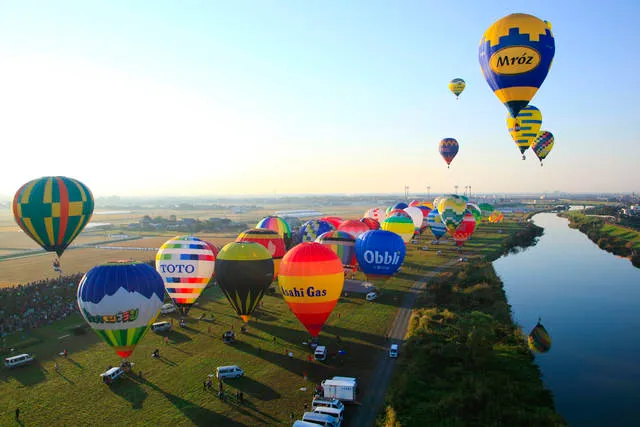
Saga International Balloon Festival is held on Japan’s southern island of Kyushu in Saga Prefecture every autumn. In 2018, the Saga International Balloon Festival was a 5 day event which was held from October 31st to November 4th. There were 111 hot-air balloons from 17 different countries. This is the largest event of its kind in Asia, attracting over 800,000 spectators every year, and best of all entry is free! This is the best thing to do if you are in the area late October to early November!
Summary
Saga International Balloon Festival is held on Japan’s southern island of Kyushu in Saga Prefecture every autumn. In 2018, the Saga International Balloon Festival was a 5 day event which was held from October 31st to November 4th. There were 111 hot-air balloons from 17 different countries. This is the largest event of its kind in Asia, attracting over 800,000 spectators every year, and best of all entry is free! This is the best thing to do if you are in the area late October to early November!
View on FacebookThe Largest hot-air Balloon Event in Asia with Over 111 Balloons
The Saga International Balloon Festival actually began in 1978 in Amagi City, Fukuoka Prefecture as the Balloon Festival in Kyushu. However, as the Festival grew in popularity, the old location proved too small. Therefore, the Festival moved to Saga City where the event is now held just outside the city along the Kase River. In 1984, the Festival became an international competition where it was given its present name and held the first Japanese National Hot Air Balloon Championships.
The World Hot Air Ballooning Championships, which is organized by the governing body for air sports The World Air Sports Federation, is held every 2 years. In 1989, 1997 and 2016, the World Championships were held at the Saga International Balloon Festival, attracting many spectators and over 100 balloon pilots each time!
2018 Saga International Balloon Festival
This year’s Saga International Balloon Festival entry list had been announced; there were 111 balloons from 17 countries! 82 of the balloons were from Japan and 29 balloons were from overseas. The Festival is split into different categories from competitive ballooning to fun events for all spectators!
The 32nd Pacific Cup had 69 balloons competing (Domestic 49, Overseas 20). It was split into the “The 35th Japan National Championships”, where 43 of these balloons competed, and the“2018 Honda Grand Prix - Game 4” where the remaining 26 balloons competed. There were 18 balloons entering the “Festival” (Domestic 11, Overseas 7), 16 balloons in the Balloon Fantasia (Domestic 14, Overseas 2) and 8 Official Balloons (all Domestic).
Balloon Fantasia and La Montgolfier Nocturne (Night Mooring)
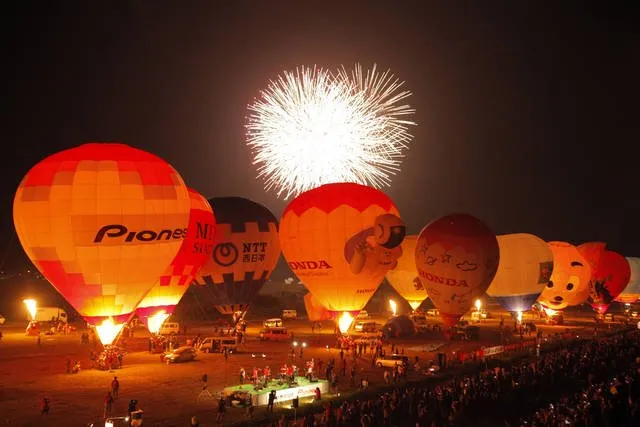
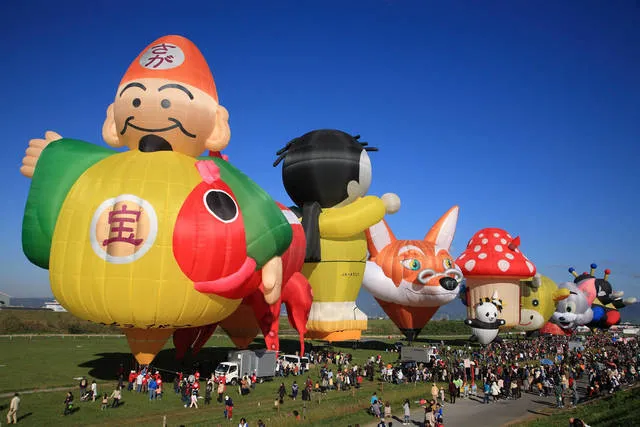 Since 1992, Saga International Balloon Festival has been holding a special event called “Balloon Fantasia”It is where specially shaped balloons of popular cartoon characters and cute animals are displayed. At night, the La Montgolfier Nocturne, or Night Mooring, event is held, where balloons lined up along the river are lit up and shine against the night sky with live music to entertain you! The grand finale is an impressive fireworks display over the Kase River as all of the balloons are lit up at once to the call of “burners on”, making the perfect end to an autumn evening.
Google Street View
To Do / See Nearby: Karatsu Kunchi – Massive 3-day Parade
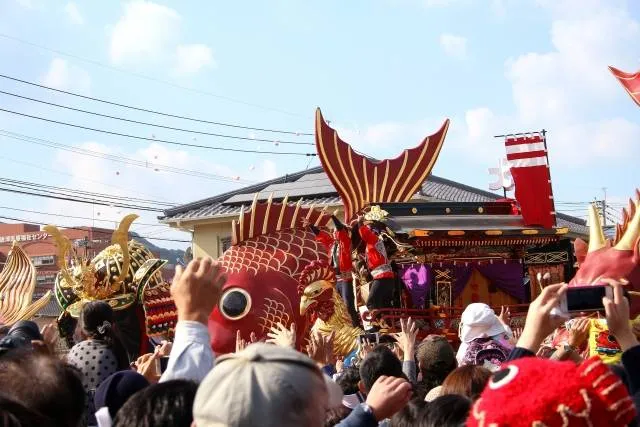 Early November is a popular time for visitors to travel to Saga Prefecture as the Karatsu Kunchi Festival is also held during this time. Karatsu City, which is about 1 hour by car from Saga City, has been holding this festival for over 400 years to celebrate the bountiful harvest. This is one of Saga Prefecture’s most popular festivals. The festival is a three day event, and in 2018 it was held from November 2nd to the 4th. One of the highlights of the festival are the “hikiyama” which are massive floats made from wood, lacquer and other materials depicting samurai helmets, lions and dragons. Each float stands around 5 to 6 meters tall and weigh from 3 to 5 tons each. The current versions were constructed between 1819 and 1876 and there are 14 “hikiyama” in total.
The oldest current version “The Red Lion” (aka-jishi) was built by the Katana-machi district in 1819, and the newest is “The Boat of Seven Treasures” (shippo-maru) built by Egawa-machi in 1876. Each float stands around 5 to 6 meters tall and weighs from 3 to 5 tons each. The floats are drawn around the city by teams of bearers from the families living in the fourteen districts of Karatsu City. This is all accompanied by the traditional festival music, lively chanting, taiko drummers, and flutists who are perched on the floats’ base.
In 1980, the festival was designated as an Important Intangible Folk Cultural Property by the Japanese government and UNESCO Intangible Cultural Heritage in 2015. With crowds of up to 500,000 it is definitely worth checking it out while you are visiting Japan!
How to Visit?
From Tokyo to Saga
It takes about 75 – 120 minutes by airplane from Narita / Haneda Airport to Saga Airport.Train
There will be a temporary train station, JR Balloon Saga Station, at the main festival grounds on the Kase Riverside for the duration of the event. The festival grounds are right in front of the station. It is about a 5-minute train ride from JR Saga Station to JR Balloon Saga Station.
Shuttle Bus
Shuttle bus services are available on Saturday, November 4th and Sunday, November 5th for visitors parking in the temporary parking lots in Saga City. The buses will be running between those parking lots and the north side of JR Balloon Saga Station. Please note that the shuttle bus services are not available on weekdays.
Car
There will be about 4,800 parking spots (over 7,000 on weekends and national holidays) around the festival grounds and in Saga City during the festival. However, using the public transportation is encouraged to avoid traffic jams. Guests who drive to the event must pay a 1,000 yen to park their car at the temporary parking lot to cover maintenance costs.
Reference List
http://www.sibf.jp/en/
https://gurutabi.gnavi.co.jp/a/a_2172/
Thumbnail image via www.sibf.jp