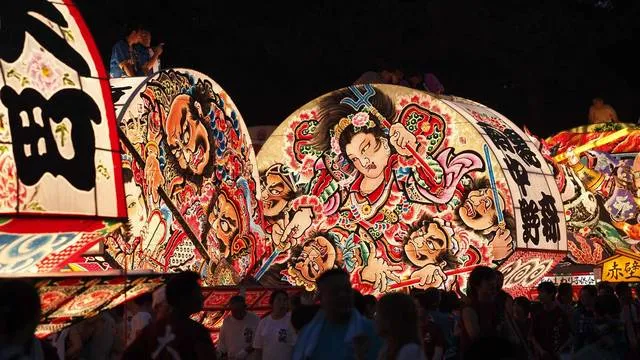
More than 20 colorful nebuta floats are paraded in Aomori city as haneto dancers skip and chant “Rassera, rassera”.With more than 3 million people gathering for the festival, it's one of Japan's largest summer festivals.Anyone can join the parade and become a haneto dancer.Join the fun and become enchanted by the detailed artwork on the floats.
Aomori Nebuta Festival
Japanese summertime is a fun, eventful season with great firework displays, Bon Odori dances and unbelievable events every weekend. Out of Japan’s many summer festivals, one of the most renowned is the Aomori Nebuta Festival (or Aomori Nebuta Matsuri, or simply Aomori Nebuta).
Held every year from Aug 2- Aug 7, the Aomori Nebuta Festival in northern Japan, is one of Japan’s most impressive and powerful float festivals. Nebuta is a large, beguiling paper float with historical figures, kabuki actors or animals painted on them. More than 20 of them parade into Aomori city, each with about 1,000 people accompanying them. Haneto dancers chant “Rassera rassera” while skipping and dancing to the rhythm of the taiko drums and traditional flutes.
More than 3 million visitors and locals gather to join this festival and this festival is said to bring about a whopping 24 billion yen to Aomori prefecture. It was designated an Important Intangible Folk Cultural Property in 1980.
The origin of the festival is uncertain. Some believe it was invented by General Sakanoue-no-Tamuramaro in the 800’s, when his army created large lanterns to scare off the enemy. The mainstream belief is that it is a variant of lantern floating.
One thing is for sure though, unlike many other Japanese festivals, Aomori Nebuta Festival is not hosted by a temple or shrine. It is a festival that has been run by Aomori’s local communities, with the pure objective of gathering people and having fun. It’s open to anybody who wants to be a part of it.
Works of Art
Nebuta floats are works of art that are difficult to preserve, which is why most of them are destroyed after the festival. Every year, new floats are made into masterpieces by artists, and so every year is like no other! They are enormous and are 5 meters (16 feet) in height, 9 meters (30 feet) in width, and 7 meters (23 feet) in depth. They usually weigh about 4 tons.
About 800 to 1,000 fluorescent lights and light bulbs are placed inside each nebuto, and in recent years it’s lit up using a power generator. They paste about 2,500 washi paper the size of a newspaper onto the wire frame. Paintings drawn are usually of famous figures from historical scenes such as warriors, Kabuki plays, Japanese myths, animals and gods. They are colorfully painted and carefully crafted so that it’s beautiful from any angle.
Although nebuta are created using only wire frames, washi paper and light bulbs, creating them is no simple process. Nebuta craftsmen start to think about the theme of their next nebuta from the day after the festival. They think about what kind of figures they want to include, how many and how big they want them to be. Then they draw a sketch of the final image, and based on that, everyone involved in creating the nebuta work together to complete the piece. Rain or shine, floats are paraded into the streets every night. The floats are pushed down the streets for a daunting 3.1-kilometer (1.9 miles) course, which takes about 2 hours in total.
On the first two nights of the festival, smaller nebuta that are usually pulled by children are paraded into the city. Out of the six days, the main nebuta usually show up on the streets from Aug 4th to the 6th. On the last day of the festival, all nebuta make an appearance in the afternoon, and then the ones that won prizes are carried out to the sea for the festival’s finale.
Beautiful bursts of fireworks decorate the night sky, while the crowned nebuta decorate the night sea, marking the end of Aomori Nebuta festival.
5 Ways to fully Enjoy Aomori Nebuta Festival
-
Dance with your Favorite Nebuta
You can participate in the parade if you are dressed in traditional haneto costume, which can be rented or purchased in Aomori city. Even if it’s your first time in Aomori, if you are wearing a haneto outfit, you are considered a haneto. You can dance with your favorite nebuta. The dance is simple but involves a lot of jumping and skipping and lasts about two hours. First timers are advised to jump moderately so they’re not completely exhausted in an hour. -
Check out the Baketos
There is no way you can miss a baketo at the festival. Baketos are dressed in eccentric costumes such as characters with rosy cheeks or anime characters, and add some fun to the festival. Anyone can become a baketo- there are no rules. Rumor has it, many Baketos are people who usually work in places such as the government. Baketos have been making an appearance at the festival since the early 1900’s. -
Visit the Nebuta Museum WA-RASSE
Learn more about Aomori Nebuta festival while you are there. The museum introduces the history, how nebuta has transformed over the years, and the detailed construction process of a nebuta. You can touch it too, which is a rare opportunity, and check how it is created with immense attention to detail. It’s right by JR Aomori Station. 4. Purchase Nebuta-related Souvenirs
All over town, you’ll see nebuta-related goods. There are towels and t-shirts with nebuta paintings, pamphlets with that year’s nebuta, among other things. Purchase some for yourself or for family and friends back home. -
Make Reservations for a place to stay outside of Aomori City
Aomori city becomes packed with people during the festival, and making a hotel reservation within the city is a hassle. If you want to stay overnight, try booking a place outside the city.
How to Visit
<By Plane> Take the plane from Tokyo (Haneda airport) to Aomori airport (approximately 75 minutes). From Aomori airport, take a taxi to JR Aomori Station (approximately 25-minutes).<By Train>
Take the bullet train from Tokyo station to JR Aomori station (approximately 3.5 to 4 hours.)
The Nebuta parade route is a five-minute walk and the Nebuta Museum WA-RASSE is a one-minute walk from JR Aomori Station.
Nebuta Museum WA-RASSE
Address: 1-1-1 Yasukata, Aomori city, 030-0803
Tel: 81-(0)17-752-1311
Reference List
http://www.nebuta.jp/warasse/foreign/english.html
https://www.nebuta.or.jp/