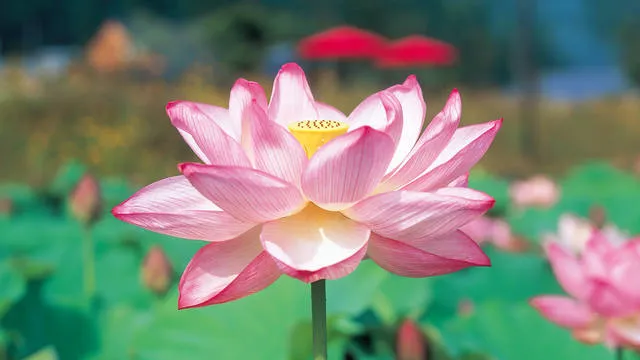
Experience lotus flower-viewing, which is not only about gazing at the beautiful flowers, but also about drinking in a long lotus stem or eating lotus ice cream.At Hanahasu park in Fukui prefecture, 130 different lotus flowers bloom in 10 different ponds.Lotus flowers from all over the world bloom there, including the legendary “Oga lotus”aka the ancient lotus.Enjoy the serene atmosphere, and get to know lotus flowers more.Join in Hanahasu park’s lotus festival in July and August.
View on FacebookHanahasu Park, Minami Echizen, Fukui prefecture
Fukui is a prefecture filled with nature, farming fields, rice patties, and fishing villages-- it’s the perfect getaway spot. 15% of the total land area is designated as Natural parks or scenic areas that are protected and managed by the Japanese Ministry of the Environment. Located along the Sea of Japan in central Japan, you can enjoy fresh seafood such as Echizen crabs with local rice and sake, and their delicious Echizen Oroshi Soba noodles (buckwheat noodles). Minami Echizen, an area in Fukui, produces more than 60% of Japan’s lotus flowers, which are sent to Tokyo and Osaka cities. Hanahasu park is a place that represents their lotus production. Every July and August, the park holds “lotus festival” where visitors can see hundreds of beautiful lotus flowers blooming everywhere in the park.
What is the lotus flower?
“As a lotus flower is born in water, grows in water and rises out of the water to stand above it unsoiled, so I, born in the world, raised in the world having overcome the world, live unsoiled by the world.”- Gautama Buddha.
Think about this quote while gazing at hundreds of beautiful lotus flowers at Hanahasu park. Lotus flower is considered as a sacred flower in Buddhism. They believe that a lotus flower’s ability to slowly grow from the muddy pond into a clean, beautiful flower symbolizes enlightenment. They come in different colors, and they all have different meanings: The blue lotus symbolizes spiritual freedom, and the red lotus symbolizes love and compassion. The pink is the most common one, and this is the lotus flower that symbolizes Buddha himself.
Lotus flowers bloom in the summer; under the warm sunlight. They have long stems, large floating leaves, with firm and long roots in the murky water. Hanahasu park in Minami Echizen of Fukui prefecture becomes a lotus paradise during the summer months of July and August. With over 130 types of lotus flowers from China, Nepal, the United States, India and Japan and other countries, you can usually see pink, white, yellow, orange lotus flowers blooming everywhere. It’s often hard for non-lotus specialists to tell the differences between the lotus flowers other than their colors but make sure you try to spot the “Oga lotus” also known as the ancient lotus, while you are there. The “Oga Lotus” is a lotus flower that was resurrected by a Japanese Botanist Dr. Oga in 1951. He found three lotus flower seeds during an archaeological dig in Chiba prefecture, and as he germinated and flowered one seed, other two seeds were sent for research to the University of Chicago. There they found that the seed was 2,000 years old. The lotus flower was named after the Botanist that revived the flower and can be seen in most major lotus gardens in Japan.
Lotus festival at Hanahasu park
Lotus flowers are edible- from their petals, seeds, leaves, to their roots. Lotus root is an integral part of Japanese winter cooking such as stewed dishes.
During the “lotus festival” season, there are fun booths at Hanahasu park. At the “zoubihai” corner, people use long stems of lotus flowers as straws to drink lotus wine (fruity white wine with lotus extract), and Japanese sake. “Zoubihai” literally translates to “elephant nose cup”, and it’s probably called that because the lotus flower’s stem is long like an elephant’s nose. The staff holds the stem for you with the large lotus leaf at the top, while you sit down and put the bottom of the stem to your mouth. The drink is poured through the top of the stem into your mouth. Apparently this practice started in China as a way to beat the summer heat. For non-drinkers and children, you can experience this with juice as well- whatever you decide to drink, you can taste the lotus extract along with your drink. It usually takes place every Saturday morning, but be sure to check the calendar before you go. Other popular booths are the lotus ice cream shops close to the park’s parking lot. The ice cream has lotus extract in it, and it is said to be refreshing and tastes a bit like tea. If you are into food, you can experience lotus food cooking such as lotus noodles at the two restaurants in the park. There are also fun activities like experiencing making paper out of lotus fiber and dying cloth using lotus leaves. Other than that the large park also has fun mazes and areas where children can run around and have fun too. So if you are traveling with children, you can let them run around at the maze while you find peace and silence at the lotus ponds. There are ten major lotus ponds in the park so there are plenty of opportunities to enjoy lotus-viewing.
The area is full of nature, and there are several hiking spots such as Mount Soma, a small mountain 492 meters high, close to Hanafusa park. There is also a hot spring (onsen) right next to the park called the “hanahasu onsen somayama.” Visitors can drop in for a quick dip in the onsen, or you can stay the night at there if you want to take a look at the lotus flowers from very early in the morning as they start to crack open. The onsen facility has beautiful drawings of lotus flowers on the walls and it is a natural hot spring. You can find perfect lotus related souvenirs such as towels with lotus extracts or lotus-shaped candles, to give as presents to your friends and families back home. If you are serious about looking at lotus flowers properly, the most recommended time to go is in the early morning. Lotus flowers open in the morning and close in the afternoon so you want to get to the park before the lotus flowers close. The park usually asks visitors to pay 200 yen to enter the park during the lotus festival season, as maintenance fee.
Come to enjoy the lotus flowers at Hanabusa park, Minami Echizen of Fukui prefecture. Calm your mind, please your eyes and appreciate their beauty. And if you haven’t had lotus roots, lotus ice creams or lotus noodles before, try them. Spend the whole day getting to know the sacred lotus flowers!
How to Visit?
A 3hr 50 min train-ride from Tokyo. One way to get there is to take the JR Tokaido-Sanyo Shinkansen from Tokyo station to Maibara station (2hr 11min). Transfer to JR Hokuriku express line and ride to Tsuruga Station (45 min). Lastly, ride the Hokuriku line to Nanjo station (27 min).Address: 64-41 Nakagoya, Minamiechizen-cho, Nanjo-gun 919-0214, Fukui prefecture (Hanahasu park)
Tel:+81-(0)778-47-8013 (Hanahasu park)
Reference List
http://www.minamiechizen.com/tabid/140/Default.aspx
https://www.goodreads.com/quotes/1187515-as-a-lotus-flower-is-born-in-water-grows-in
http://www.hokurikushinkansen-navi.jp/pc/news/article.php?id=NEWS0000007415