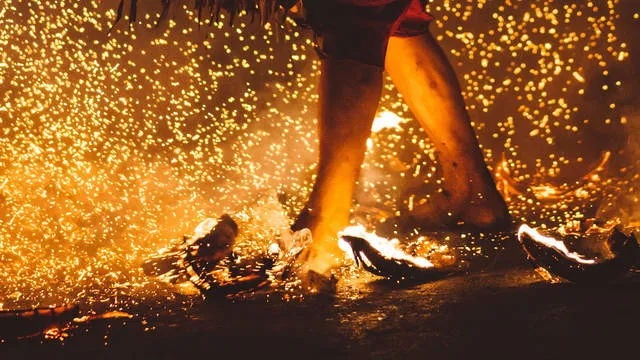
Cleanse your soul and pray for a healthy and safe New Year at Nyoirinji Temple in Fukuoka.Every January 17th, they have a Hiwatari (of crossing fire) ritual at the temple where not only Buddhist monks but young and old men and women, and even children walk on top of burnt wood with their bare feet.
What Exactly is a Hiwatari (crossing fire) Ritual?
Hiwatari (or crossing fire) is a Buddhist rite performed in some Shingon sect temples as an act of purification. It involves an enormous fire being made by Buddhist monks while they pray for everyone’s good health and peace. The highlight of the ritual is when Buddhist monks walk on top of the burnt wood with their bare feet, and spectators are also given the opportunity to join them, with their bare feet too.
At Nyoirinji Temple in Fukuoka Prefecture, the Hiwatari ritual takes place on January 17th every year. The day begins with a Buddhist ceremony in the morning, followed by the Hiwatari ritual in the afternoon from 1 PM.
At Nyoirinji Temple in Fukuoka Prefecture, the Hiwatari ritual takes place on January 17th every year. The day begins with a Buddhist ceremony in the morning, followed by the Hiwatari ritual in the afternoon from 1 PM.
Niyorinji Temple's Hiwatari Ritual
Branches and leaves of Japanese cypress are stacked on top of each other until they reach 3m in height and form a 2m circle in width. A big circle is formed around it with locals and tourists from different parts of Japan. Most are seated, while they wait for the Buddhist monks to arrive.
Then you hear the Buddhist monks arriving with the sound of conch shells being blown, signaling that the religious ritual is about to begin. As the Buddhist monks start to appear, you may be able to tell that there are different ranks. The highest-ranking monk (usually the Buddhist monk with the longest years of training) wears red (scarlet). The Buddhist monk wearing red takes a special seat by the fire to pray from a distance.
After the branches are lit, soon the area becomes smoky and then eventually there is a large flame in front of you. The Buddhist monks are all chanting or blowing conch shells or striking bells all with the objective of praying for a good, healthy and safe year. The Buddhist monks then start to throw the gomagi or wooden sticks on which prayers are written, into the fire. It is believed that when the gomagi burn, all malevolent spirits that try to block the wishes written on the gomagi to come true are transformed into good spirits. After the fire is done, the place is purified with salt in preparation for the highlight of the ritual, the Hiwatari.
First, the Buddhist monks walk on top of the burnt wood, then spectators follow. Spectators put their shoes into a bag and become bare feet. As they walk on top of the burnt wood, many put their hands together to pray for their family’s good health and happiness.
Not only grown men and women, but little children also participate in the Hiwatari. According to some participants, if you line up in the end, the burnt wood is not too hot to walk on. So if you are with children who want to try, it’s a good idea to go last. However, if you’re feeling adventurous, go in the beginning- but be prepared to tippy toe and walk really fast.
On a side note, you will most likely become very smoky afterward—especially your hair, clothes, and shoes. You might want to plan your day so that you have time to head back to where you’re staying right after the ritual, to take a shower and change your clothes.
Hiwatari is considered to have cleansing effects on one’s soul, and this ritual, which has been going on at Nyoirinji Temple for over 40 years, is attracting more and more locals and tourists year by year. On the day of Hiwatari, there are food booths by the entrance of Niyorinji Temple so that people can enjoy food and drinks. Sometimes, obento or Japanese lunch boxes are passed out to spectators, along with a hot cup of green tea.
Also Known as Frog Temple
Located in the middle of a residential area in Ogori city of Fukuoka Prefecture, Nyoirinji Temple is commonly referred to as “Kaerudera” or Frog Temple. The reason is simple—the temple contains more than 5,000 frogs in all kind of forms like figures and drawings. It’s a funny world of frogs. You will see a message next to some major frog figures. For example, beside a frog couple, there is a hand-written message from the temple that reads, “Have fun being a married couple! Have fun!”
There is a big frog statue where you sort of dive into the frog’s mouth. By diving in the frog’s mouth and coming out from the other end, the message is that all bad things will turn out good. You will not only see children diving into the mouths but big adults too, which is quite a site. The temple is a fun place to visit for both children and adults.
Why are there so many frogs at this temple? It's the hobby of the Buddhist monk that runs the temple. He started his collection more than 25 years ago when he bought a frog statue, hoping to return home safely from his trip to China (Kaeru means frog but also means return). His mission is to make Nyorinji temple a fun and open place that welcomes everybody with arms wide open.
Reading the above, you may not believe it, but Nyoirinji Temple was founded in 729, making it the oldest temple in Ogori city. In it, you will find a Nyoirin Kannon statue. Apparently, this is the only Kannon statue in Japan that is standing up, not sitting down. They also have a wooden Nyoirin Kannon statue that is designated as tangible cultural property by Fukuoka prefecture, hidden away inside the temple. They only show the statue every 12 years, so the next time it will be shown is in 2025.
How to Visit
Fukuoka Airport is about 2 hours from Tokyo Haneda Airport. The temple is located about an hour away from Fukoka Airport by train. After transferring to the Nishitetsu Omuta Line, get off at Mitsusawa Station, and walk about 15 minutes.
Address: 1729 Yokoguma, Ogori City, Fukuoka 838-0105
Tel: +81-942-75-5294
Address: 1729 Yokoguma, Ogori City, Fukuoka 838-0105
Tel: +81-942-75-5294