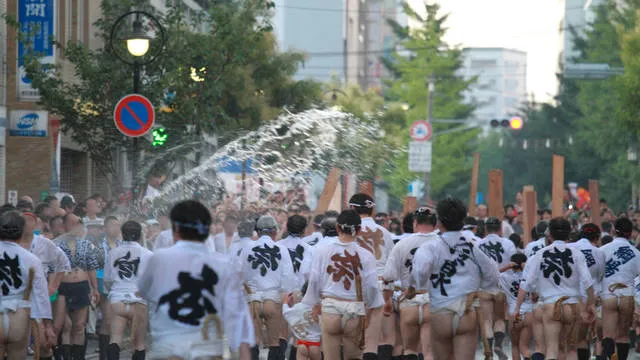
Men in traditional outfits carry five-meter kakiyama floats across Hakata ward in Fukuoka, Japan.Designated a UNESCO Intangible Cultural Heritage, this lively festival signifies the beginning of summer.
Facebook で見るAn Exciting Festival in Fukuoka:Hakata Gion Yamakasa
“Oisa- Oisa” the men shout out, as they carry and push a 5 meter (16ft) tall kakiyama float around Hakata Ward, Fukuoka city.
It’s quite a sight—men ranging from young to old join forces to move the kakiyama float forward fast. There are no wheels to the float, it weighs one ton, and it’s built so that men with different heights can push it forward together. The actual carriers are usually young and strong, while the runners surrounding the float include children and the elderly. The carriers and runners are all male (no females participate).
Seven districts of Hakata participate in the race with seven different kakiyama floats and push them along a 5K course. It’s a time trial race. The roads are closed for the festival and traffic officers stand by the ropes to make sure nothing dangerous goes on. Spectators gather behind the ropes as they clap and cheer the teams that pass by. This race happens on the last day of the Hakata Gion Yamakusa, an exciting festival that takes place every year from July 1st to July 15th in Hakata, Fukuoka. It’s a festival with a history of more than 770 years, and is hosted by one of Hakata’s most important shrines, the Kushida Shrine. The race that takes place is called Oiyama, and it’s the festival’s main event.
Oiyama: the Main Event
With a countdown announcement, the oiyama begins at exactly 4:59AM. First, all the districts present their kakiyama to Kushida shrine by making a U-turn at the pole (flag) inside the shrine. They take about 30 seconds to do that (this is timed too), and go on to finish the race. There are five-minute intervals between each presentation. Viewing this is extremely popular and paid seats that are available inside the shrine sell out in 15 minutes after becoming available. Free seats are also available but usually the waiting line for it is full by noon of the 14th. Many spectators who couldn’t go inside form large crowds outside of the shrine, enjoying the sounds of the ceremony through speakers.During the run, large amounts of water are sprinkled on the carriers and runners. The main reason for this is to cool them off and prevent them from getting sick. It’s also used to reduce friction between the kakiyama float and the road.
Race participants all wear a Mizuhappi (water vest), a traditional outfit. Take a look at their headbands (rolled up towels) as they come in 7 different colors/patterns, each showing different roles of the participants. For example, participants with no special role wear patterned towels. Experienced participants with important roles such as directors wear red towels. The vest indicates which district the participant is from. The loincloth is similar to what sumo wrestlers wear but with cloth hanging down the front side. The navy blue tabi shoes make running on asphalt easier.
After the teams finish the race, the kakiyama floats are brought back to their district and are taken apart. The decorations and puppets of the floats are placed on stands and the carriers shake the stand while the crowd sings along. Viewing this gives many locals a sense of accomplishment and prepares them for Fukuoka’s hot summer.
Other Events during the Festival
In 2016, the Hakata Gion Yamakasa was registered as UNESCO Intangible Cultural Heritage.
Some events take place every day during the Hakata Gion Yamakasa. You can watch the teams practice and get ready for the oiyama. You can view the kazariyama exhibition. Two types of floats are used at the festival: kazariyama floats and kakiyama floats. Kazariyama floats are usually more than 10 meters (32ft) long and are created by Hakata’s puppet craftsmen for display. Kakiyama floats are used specifically for carrying and pushing them around the city and are 5 meters (16 ft) long. The kazariyama exhibition takes place for the entire two weeks and shows 14 different kazariyama floats on display at different areas of Hakata. They're colorful, and local puppet artisans carefully handcraft the puppets. Each one has a different story.
Hakata Gion Yamakasa is fun and entertaining. When you view the race, be prepared to get wet too (and don’t forget to protect your phone and camera from damage). After the festival, you should visit the historical Kushida shrine, the place where locals pray for business prosperity, and take a look at other sites in Fukuoka city. If you want to go shopping, you should go to Hakata station, there are many shops to see both inside and outside of the huge station. If you want peace and quiet, go to Ohori park- there is a beautiful lake in the middle. And if you are a ramen lover, you have to try their favorite Hakata ramen. You can eat it anywhere, but for a real Fukuoka experience, try it at a yatai (street stall). You'll enjoy friendly conversations with strangers at the counter.
So choose Fukuoka as your travel destination in July, and experience the fun and traditional float festival, Hakata Gion Yamakasa.
How to Visit?
It's takes about 2 hours from Tokyo to Fukuoka. Gion station, which is where Kushida shirine is located, is 3 stops by subway from Fukuoka airport.Address:
1-41, Kamikawabata-machi, Hakata-ku, Fukuoka (Kushida Shrine)
Tel: +81-(0)92-291-2951 (Kushida Shrine)