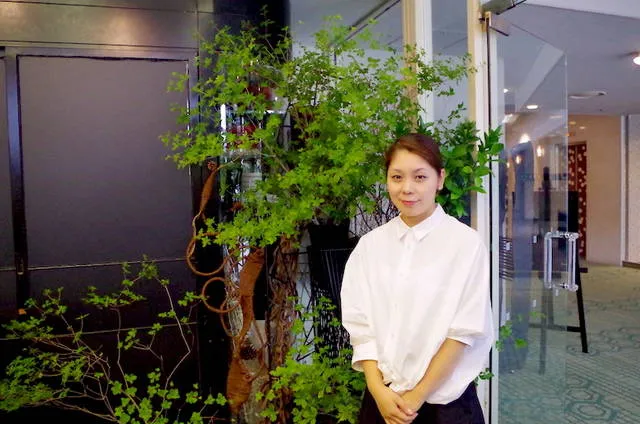
content: Ikebana is a traditional Japanese art of arranging flowers. Among the thousands of Ikebana schools that exist, Yasuka Okubo belongs to the school of Sogestu, a school that emphasizes free self-expression.
Summary
Ikebana is a traditional Japanese art of arranging flowers. Among the thousands of Ikebana schools that exist, Yasuka Okubo belongs to the school of Sogestu, a school that emphasizes free self-expression.
This interview includes talks about the Ikebana industry and what Yasuka Okubo does and would like to do in the future.
Even Stumps And Driftwood Turn Into Art!
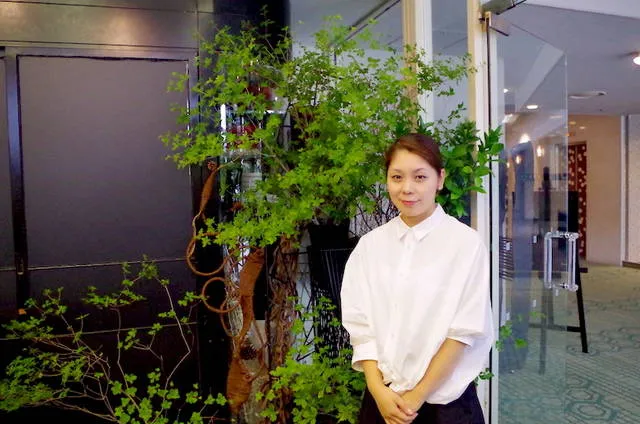 Interviewer: What kind of work do you do as an Ikebana artist?
Yasuka Okubo: I teach Ikebana at this studio and at junior high schools. I do Ikebana demonstrations overseas and I also make arrangements for hotels, shops and companies. At hotels and some companies, I arrange pieces that welcome guests and clients in all sorts of sizes. Apparently they often spark conversations among visitors and employees.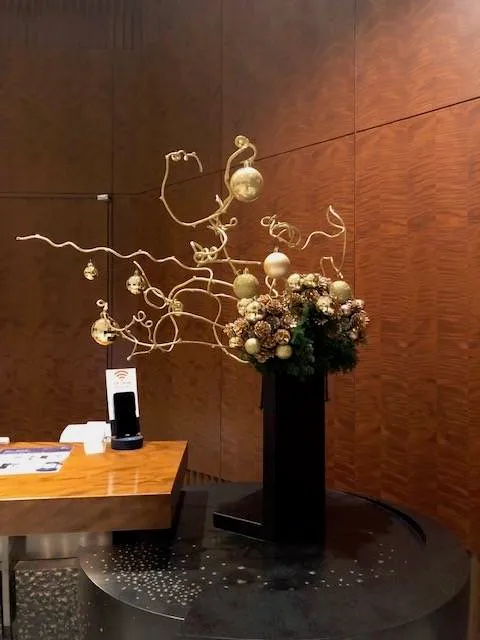 Photo: A Christmas-themed Ikebana arrangement by Yasuka Okubo, placed at a hotel reception.Interviewer: I can imagine it being a great conversation starter! What kind of flowers do you arrange at the companies’ entrance?
Yasuka Okubo: Something that matches the season is of course something I keep in mind, but I also try to add unusual materials from time to time; the type of flowers or branches you would not usually find at your local flower shop. We always have a monthly message to people viewing the flowers, which includes the names of the flowers used for the arrangement. I like to arrange my flowers in a contemporary way.
In Sogetsu, our school of Ikebana, we are free to make arrangements in any way we like. We of course have to learn the basics first, and understand our plant materials first, but after acquiring the basic skills necessary, Sogestu artists enjoy expressing themselves freely. We use various types of vases- it could be Western/Eastern, contemporary/traditional, colorful/monotone, round/long, basically anything of your choice. Even a cup could serve as a vase! Free self-expression is what the school of Sogetsu is most known for. So I like to use driftwoods, tree stumps, and other plant materials in my work. 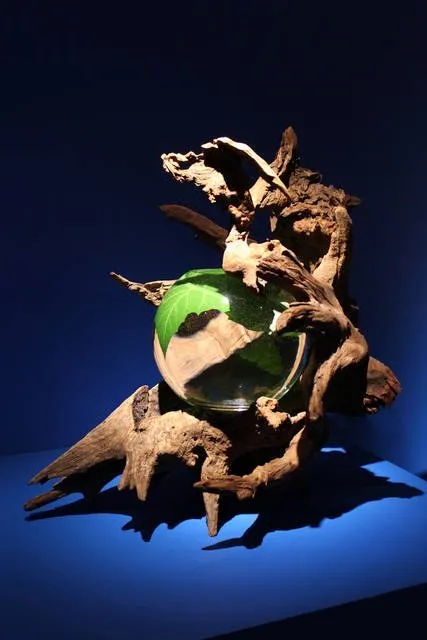 Photo: Work by Yasuka Okubo using driftwoodFor example, fallen tree branches. Sometimes strong typhoon winds bring down trees or break large branches off trees. I don’t see those branches as waste. I find beauty in them and try to give them life one last time by including them in my pieces.
Interviewer: That is beautiful. How do you find them?
Yasuka Okubo: There is one staff member that also works as a gardener for Japanese gardens. He gives me a call saying, “There’s a great branch” before he throws it away. Thankfully, word has spread and now his workmates also let him know if there’s great plant material that could perhaps be used for my work. Interviewer: That is a great way to upcycle tree branches!
Going Around The World With Just A Pair Of Scissors
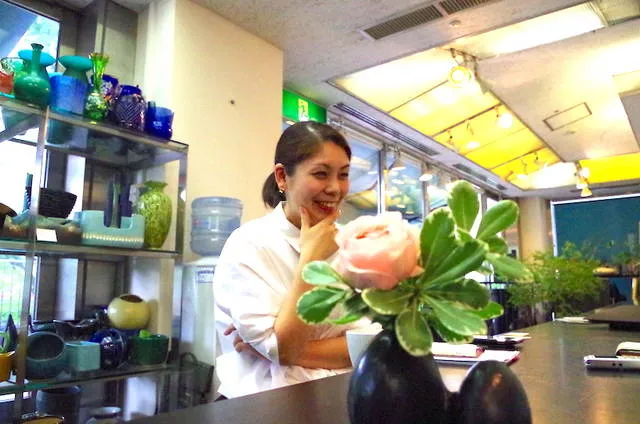 Interviewer: You mentioned earlier that you also go overseas. What do you do there?
Yasuka Okubo: We go to teach and to demonstrate but often, Japanese ambassadors invite us to demonstrate Ikebana in the country they reside in. We go to Europe, the U.S, Asia- basically everywhere in the world. We go there with our scissors only, and use local plant materials and vessels to arrange the plant materials in the Sogestu Ikebana way. It’s to show people in other countries the beauty of Japanese culture. 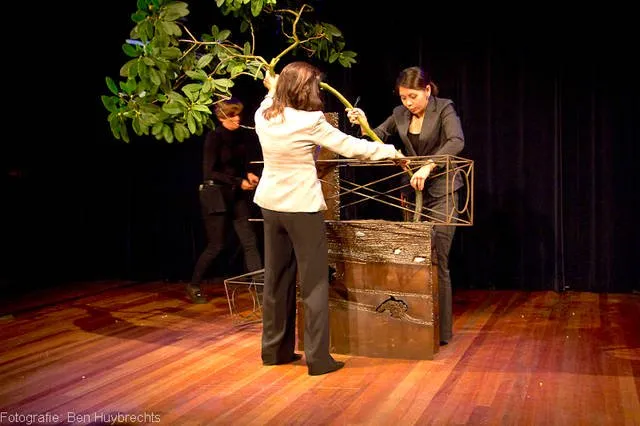 Photo: Yasuka Okubo in the Netherlands, supporting the Ikebana demonstration of her mother, who is also an Ikebana artist.Interviewer: Is there time to think about what kind of piece you want to make there?
Yasuka Okubo: No, not at all. We have a set theme but we don’t think about what we want to make before we go. If we do, we’ll panic if the country doesn’t have the plant material we had in mind. Instead, we take about two days exploring local flower shops, parks, the demonstration venue, and also look for a good vessel, and then we use all the local materials we found on demonstration day. When we are overseas and need to demonstrate, we need to keep an open mind and create our pieces based on inspiration.
The demonstration is done by two people and takes about an hour. Sometimes we use drills to stop long, thick pieces of wood from falling over. I’ve been told that it’s fascinating to watch someone like me use a drill. It’s challenging but fun. 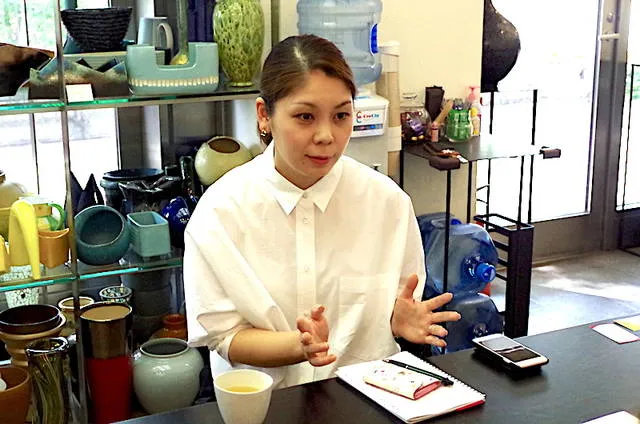 Interviewer: Is there anything you like to tell the people watching your Ikebana demonstration?
Yasuka Okubo: Other than the basics like how we arrange the flowers, we try to convey how we think in Ikebana. It seems many people find it strange that flowers can be arranged without using a sponge.
We often get asked about the difference between Ikebana and western flower arrangements. One major difference is, with Ikebana the artist arranges the plant materials while looking at the balance with the empty space surrounding the piece, and also looks for a good balance with the vase. Ikebana artists find the right balance by looking at the details of every leaf, branch and flower, find its originality, and find the right balance. 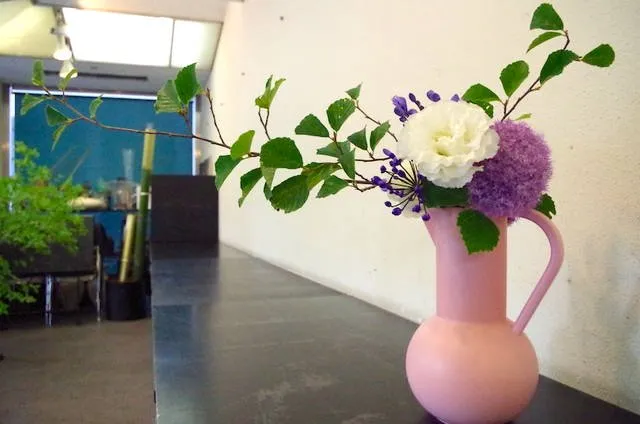 Photo: Yasuka Okubo comments, “I fell in love with this vase yesterday and had to buy it.”
Yasuka Okubo: One of the basic practices in Ikebana that some teachers still use in their lessons is having the students sketch their own pieces after they are done arranging the flowers. With drawing, one pays more attention to detail, for example, the details of each plant, the angles of each plant they placed, and their use of space. It makes them think about what they could have done to improve their piece.
In Western flower arrangements, the focus is more on colors and how the flowers look as a group and how to make the room brighter using flowers. I also find Western flower arrangements to be a powerful way of presentation and there are many things I learn from seeing Western flower arrangements too.
I believe Western flower arrangements were originally created to fit the European home, which was often made of bricks, where as Ikebana was originally created to fit the Japanese home, which was made of paper walls and wood. Architectural differences have definitely played a major role in how the flowers have been presented in each style. In recent years, there are parts of Sogestsu school of Ikebana and Western flower arrangements that have become more similar, than in the past. I think we are inspired by one another. I have heard that some top artists of Western flower arrangements actually study Ikebana too, in order to refine their skills.
Interviewer: Where is the most recent country you visited to perform?
Yasuka Okubo: China. I find it intriguing that our neighbors are showing more interest in Japanese culture. 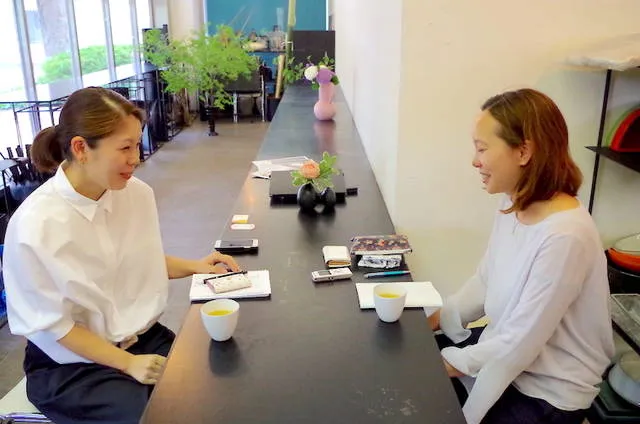 Interviewer: How do you think Ikebana is viewed in Japan?
Yasuka Okubo: Ikebana was really booming in the 1960’s to 1980’s, and many women, especially housewives, did Ikebana as a hobby or tried to become qualified to teach in those days. It died down for a while but I feel that we’re starting to gain attention again, as something new to learn. I also actually catch a lot of people watching me when I am working on my piece at office entrances. Some people come up to me to ask about the details of my work, which shows that many Japanese people still enjoy Ikebana.
Some people say they have no space in their homes to place a flower arrangement but that’s never the case. I tell people to just try arranging flowers somewhere in their home. The room’s atmosphere changes drastically, even with just one flower, and it actually ends up motivating many people to get rid of some things and clean the areas surrounding the arrangement. Some people also say that flowers are expensive, but I tell them that it’s not that different from buying a cup of coffee or desert.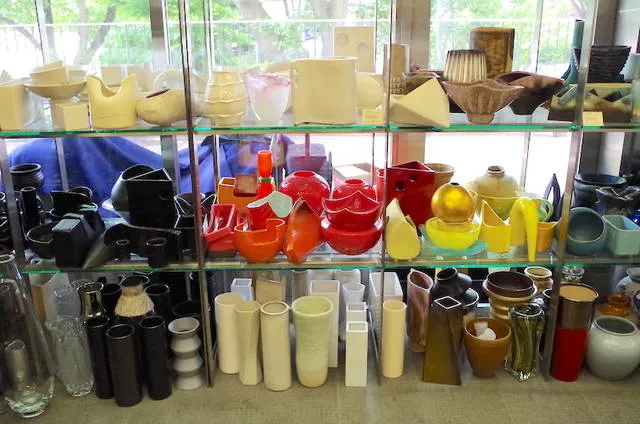 Photo: The studio’s vases used by students learning Ikebana.
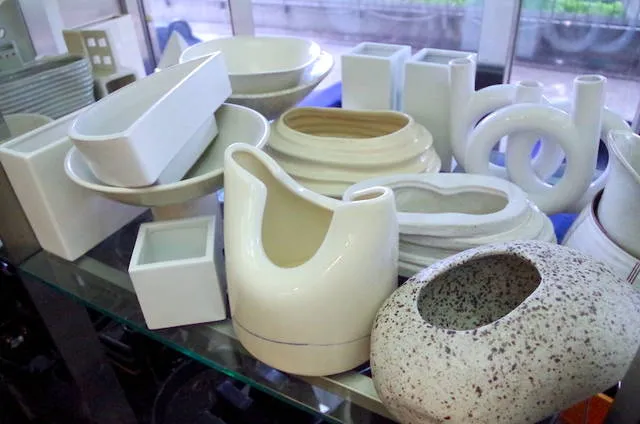 Photo: “Sometimes tourists come in thinking that they could purchase our vases!” comments Yasuka Okubo.
A Life With Ikebana Since Birth
Interviewer: Why did you decide to learn Ikebana in the first place?
Yasuka Okubo: I was born into an Ikebana family. My grandfather, grandmother, mother, aunt, uncle, and even my sister do Ikebana professionally. The entire family is Sogestu Ikebana artists and teachers. I was never forced to do Ikebana, but I guess I was affected by my surroundings. Before I knew it, I found myself supporting my mother and being an Ikebana artist myself.
Interviewer: As an artist, how do you get inspirations?
Yasuka Okubo: Although I haven’t been able to go recently, I want to go hiking or somewhere with lush nature. I always keep my eyes open and check out interior designs and decorations, displays at shops, flowers and vases at restaurants. I also like to look at architecture too.Whenever I work on a piece, I decide on a theme. Even with a demonstration, I always have a theme, or else my work will look like it’s all over the place. That’s why it’s important to refine my inspirations.
The World Of Ikebana Can Be More Fun And Casual
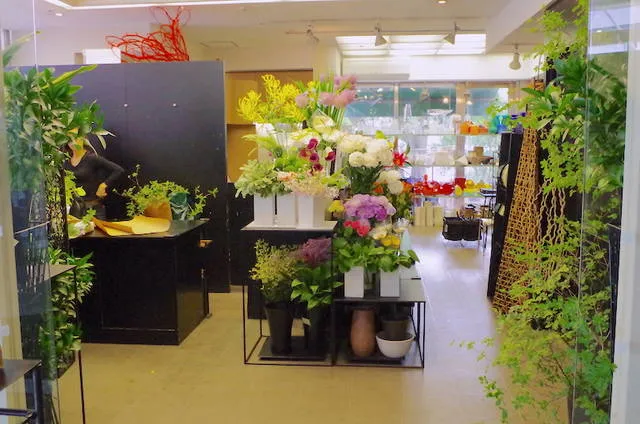 Photo: Ikebana Atrium’s Shop and Studio
Interviewer: Do you have any future goals?
Yasuka Okubo: Ever since I gave birth to my son, my view of what I want to offer to the world through Ikebana has changed. I want our children to become more familiar with Ikebana. They don’t have to become professional Ikebana artists but I want them to know the joy of arranging flowers. In order for that to happen, I think it’s necessary for parents to understand the greatness of Ikebana too. I want to therefore teach children and their parents the beauty of Ikebana.
One other mission I have is to convey the message that Ikebana is not only about flowers and plants. It’s about the vases and the tools too. The tools we use such as our scissors don’t have to be black or silver, they could come in cuter colors. There are so many lovely contemporary vases from all over the world too. I want to send the message that looking for the right materials is part of Ikebana too.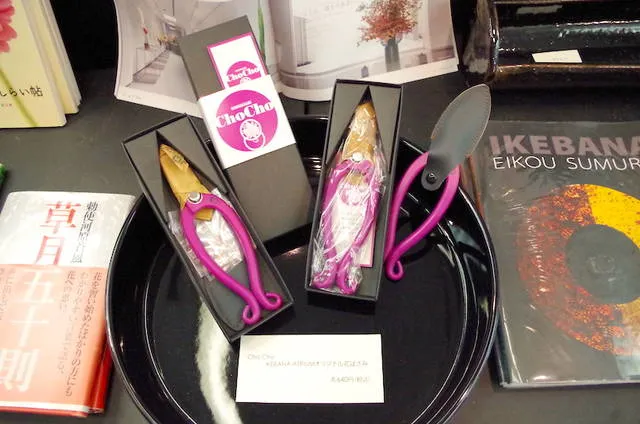 Photo: Pink scissors made by Ikebana AtriumYasuka Okubo: In other words, as an Ikebana artist, my mission is not only to try to create inspiring Ikebana pieces, but also to promote the beauty of Ikebana to the rest of the world.
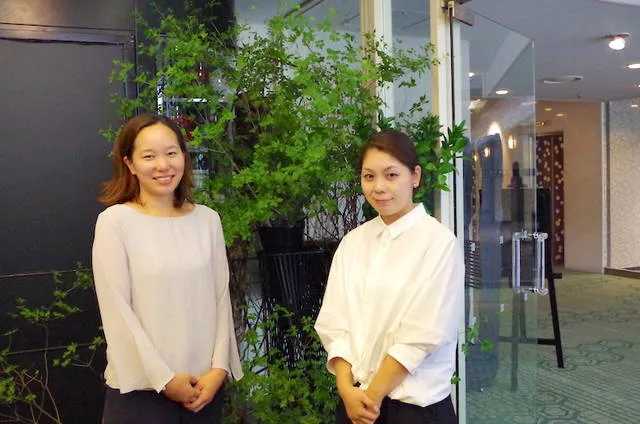 Try to see the world through talented Ikebana artist Yasuka Okubo’s gentle eyes and you might just start to see the beauty that she sees in the world of Ikebana. On my way back home from talking with her, I know that I paid a lot more attention to the fallen tree branches on the roads, and flowers that were blooming in the sidewalks, and brought some home with me to try to give them a new life in our living room.