content: We visited the Kintaro Ame factory to find how they were made. What amazed us was the production technique with which the giant Kintaro’s face as large as 35cm in diameter was turned into the size of a Japanese 1 yen coin. We were highly impressed by their extraordinary artisanship.
Summary
We visited the Kintaro Ame factory to find how they were made. What amazed us was the production technique with which the giant Kintaro’s face as large as 35cm in diameter was turned into the size of a Japanese 1 yen coin. We were highly impressed by their extraordinary artisanship.
The Main Shop Of Kintaro Ame Is Located In Tokyo
A “Kintaro Ame” is like western rock candy. “Kintaro” is a fabled boy hero in a Japanese folk tale and “Ame” means candy in Japanese. Kintaro Ames characterize the face of “Kintaro” which appears on each slice of candy wherever it is sliced. Do you know that the main shop is in Tokyo? The shop’s name is, as the candy’s name indicates, “Kintaro Ame Honten.” Their business started as a stall-keeper in the early Meiji-Period, and now it is run by the 6th owner of the original shop.
While viewing their website, a stunning photograph caught my eyes, a massive “Kintaro’s face” is about 35 cm in diameter and is larger than a human’s face, featuring a unique expression that we have never seen before. 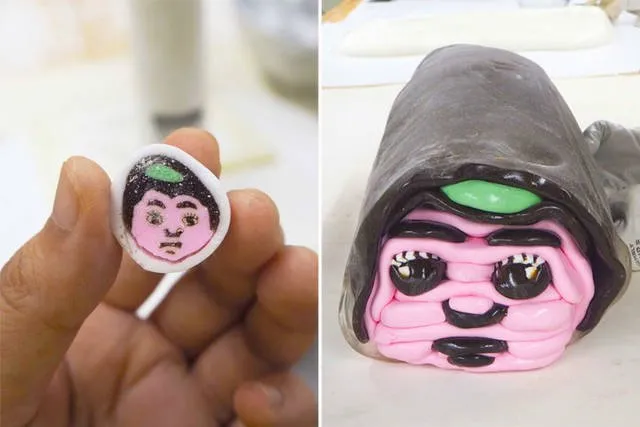 Photograph: Kintaro Ame (left) and Kintaro’s face before being commercialized (right). By Ayako Takahashi on our visit in July 2018What an amazing process! How does the massive face turn into the familiar small one? How on earth do candy-makers stack so many layers? Let’s check it out!
Air Conditioning Is Banned At The Workspace For Kintaro Ame
The Kintaro Ame Honten is within one minute walking from the Hibiya Line Minowa station. 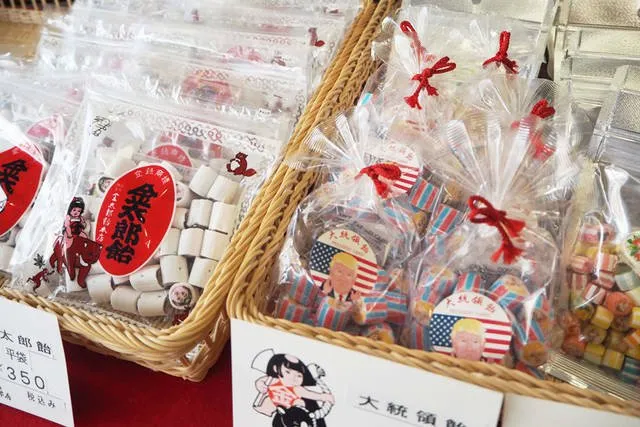 Photograph: There is a variety of candy with colourful motifs at the shop. By Ayako Takahashi in July 2018The factory is on the 2nd floor. While heading there, we found the temperature is different from the shop floor. Although our visit was in late July, the makers were working without any air conditioning.
“The candy base needs to be soft to be shaped. As air conditioners make it cool down quickly, we cannot use it.” Mr Watanabe, the 6th owner, said.
Basically, seven or eight candy makers are involved in the production. They use machines in part of the process, but it still requires artisans’ manual work. It is said to take 2-3 years to become a full-fledged professional for Kintaro Ame.
Air Is Key To Create Colour And Texture
Ame-making starts from melting a base candy. The melted candy is very hot, about 90 degrees. 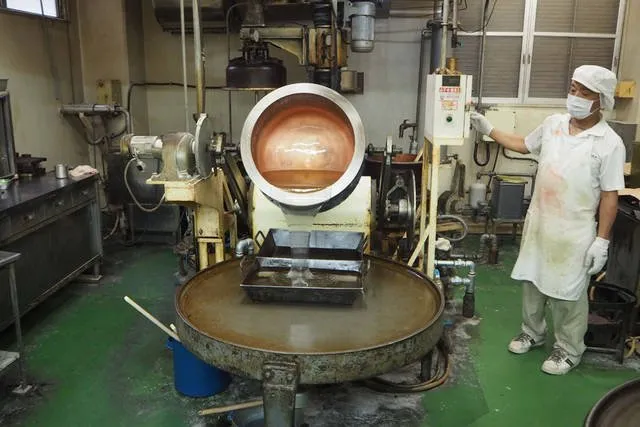 Photograph: Thick syrup and sugar are boiled in a big pot. By Ayako Takahashi in July 2018The candy was cooled down and was made into a round shape by candy-makers. Then, air is kneaded into the candy using a rice mill equipped with a revolving device. In a flash, the transparent colour turned whitish.
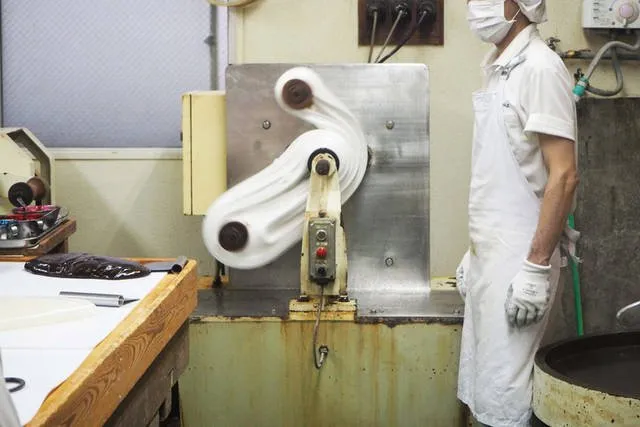 Photograph: Kneading air into the base candy to change the original colour to whitish. By Ayako Takahashi in July 2018Apart from the colour, air influences another element of Kintaro Ame. The brittle-like texture is created from this process. The air is also a driver for making it less sticky so that it does not annoy your teeth.
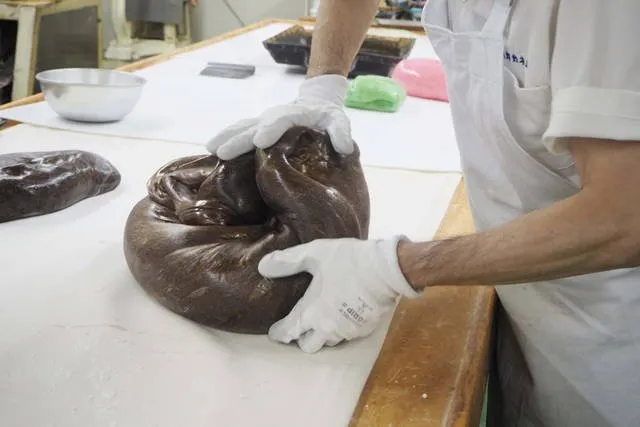 Photograph: After red food colouring is mixed, it is finalized with a rice mill. By Ayako Takahashi in July 2018
Roll Over A Giant Face 35 cm In Diameter
After colouring the base candy, the face of 35 cm in diameter is assembled by a team made up of four or five candy-makers. Each of those stacks each layer. Their work started naturally without any hesitation. During the course of the work, they were relentlessly working without making eyecontact as well as no verbal exchange.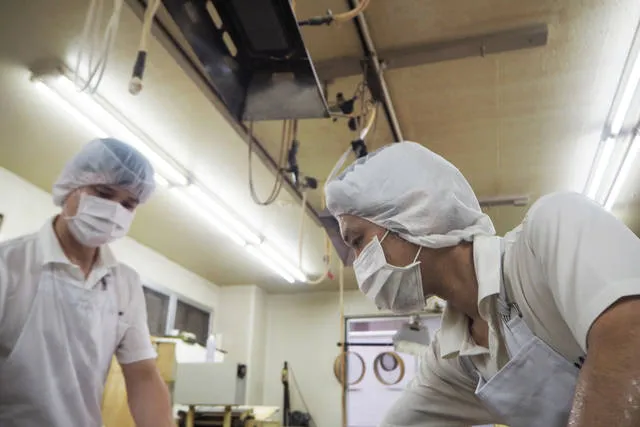 Photograph: The candy-makers intensively focus on their work. By Ayako Takahashi in July 2018Do they hold a meeting to share manufacturing details? When I asked, Mr Watanabe said: “We have a meeting but it is not a kind of formal one. Even so, when viewing a final drawing, I can visualize what I need to do in a team.”
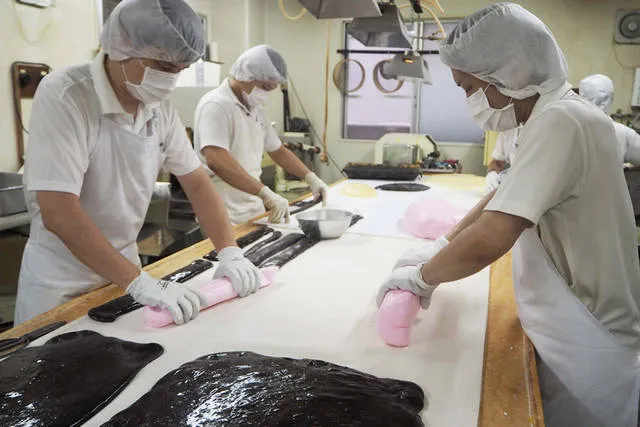 Photograph: The candy-makers commit themselves to achieve each responsibility. By Ayako Takahashi in July 2018.
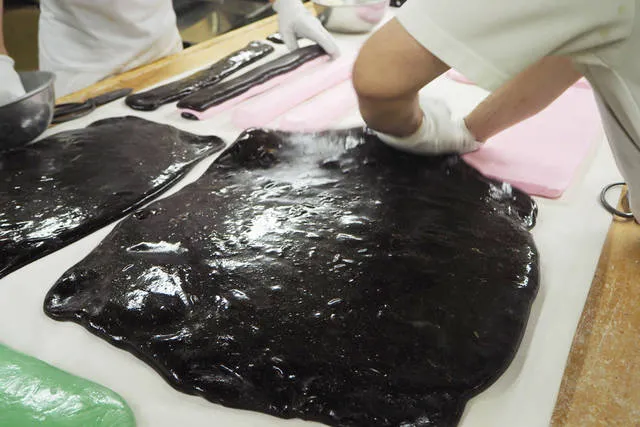 Photograph: Whoops! A candy sticks to the other one. By Ayako Takahashi in July 2018Throughout our visit, we learned that all the candy-makers know what each individual is doing. For example, if one of the candy-makers is finding a pair of scissors to peel a sticky piece out of the workbench, instantly, another maker comes to help the task.
“Shaping the base candy is a race against time. Before it hardens, we have to stack as the design shows, but just the speed is not a matter. We need to adjust our timing in accordance with others’ progress by paying attention to them.” Mr Watanabe said.
As you can see in the photograph, the parts of the face, mouth, nose, eyes, and eyebrows, were assembled, and gradually, it is starting to look like a Kintaro’s face.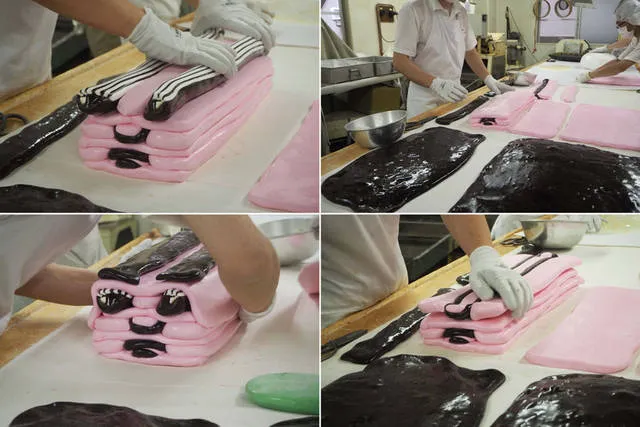 Photograph: Kintaro’s face is assembled. His eyebrows are created with alternating layers of white and brown. By Ayako Takahashi in July 2018
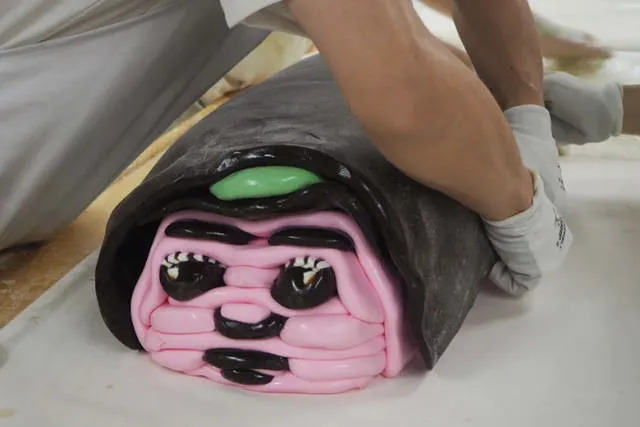 Photograph: The initial product has no eyelashes. 6 pieces of the eyelashes were created about 50 years ago. By Ayako Takahashi in July 2018After the assembling process, they repeatedly roll it over to make it a cylindrical shape.
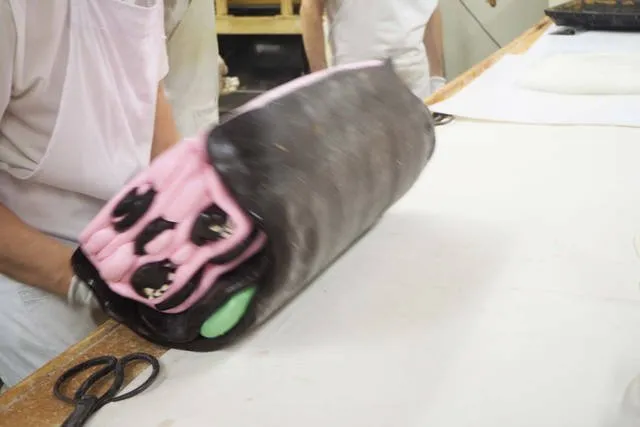 Photograph: They roll the Kintaro over. By Ayako Takahashi in July 2018
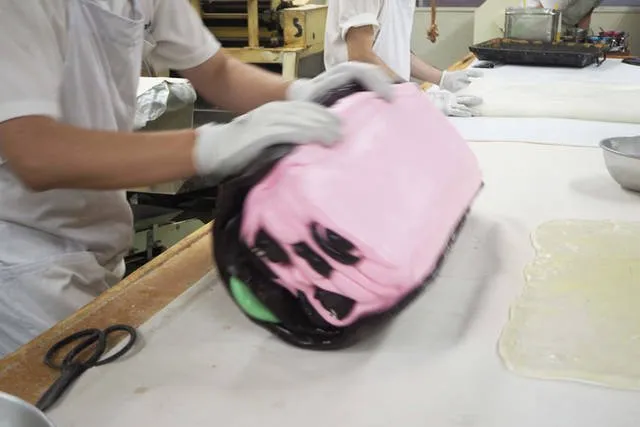 Photograph: They roll the Kintaro over. By Ayako Takahashi in July 2018The cylindrical log is wrapped with a widely stretched white base candy. Next, the log is stretched into a size that fits into a batch rolling machine, and the edges are squeezed. Two candy-makers carry the candy whose weight is about 40kg into the machine.
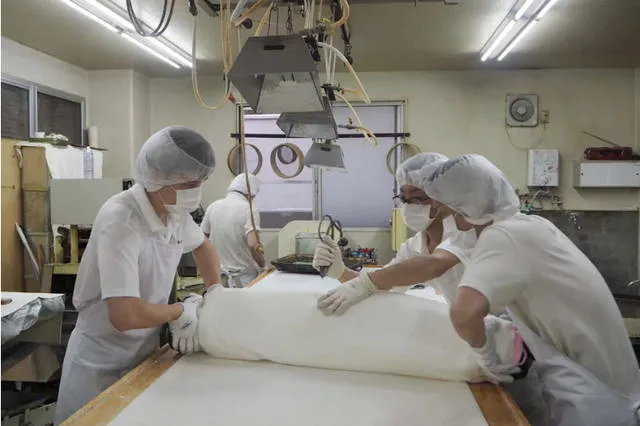 Photograph: Edges are squeezed. By Ayako Takahashi in July 2018
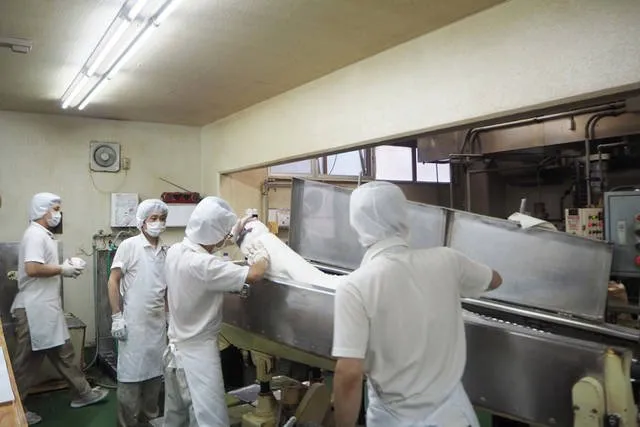 Photograph: The candy-makers place it into a rolling machine. By Ayako Takahashi in July 2018
Magic! A Giant Face Shrunk To 2cm In Diameter In A Flash
Shortly after the giant was thrown in a batch rolling machine, it started to churn out a long thin log. The elongated Kintaro is coming out of the machine one after another. A candy-maker stands by the machine in order to hold a thin log coming out thick and fast, keeping time with the production speed.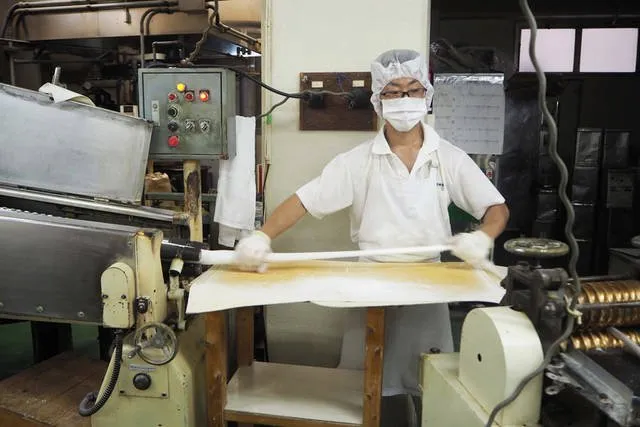 Photograph: She pulls out the long and thin log professionally. By Ayako Takahashi in July 2018The thin log was cut to at the same width as their working bench and rolled over until it cools down and was sliced into bite-sized pieces. Here they are! This is a familiar-looking Kintaro Ame.
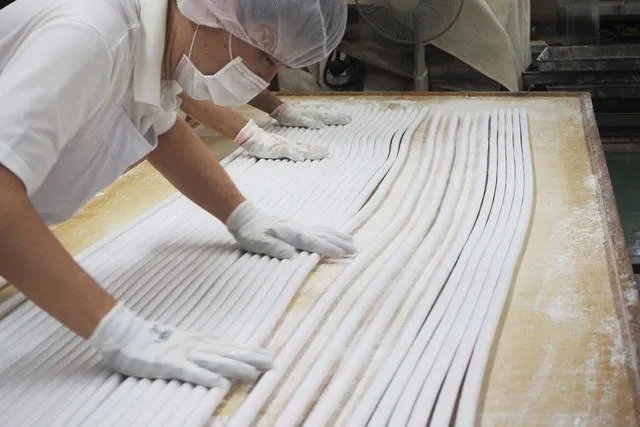 Photograph: The candy-makers roll logs over on the workbench until they are cooled down By Ayako Takahashi in July 2018
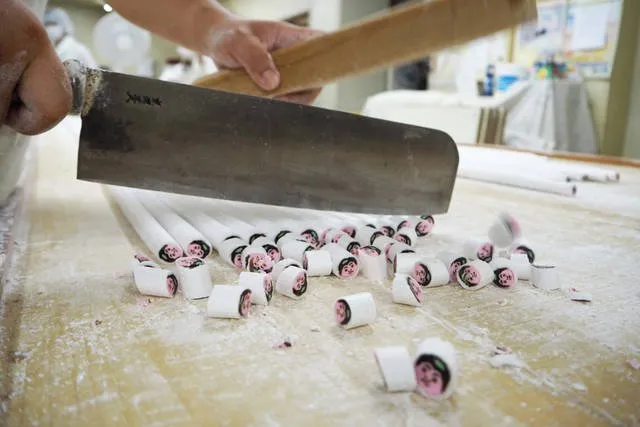 Photograph: The thin log is sliced. By Ayako Takahashi in July 2018
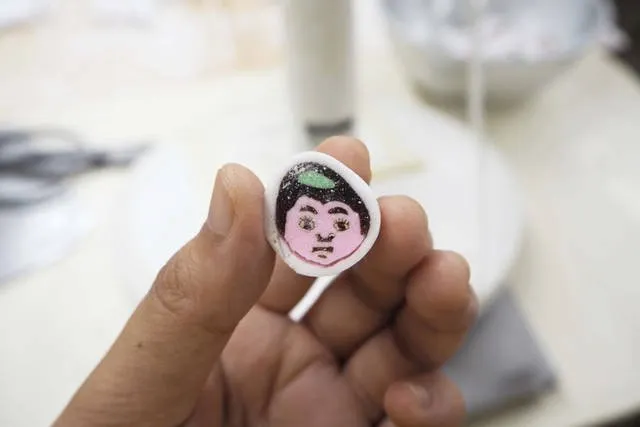 Photograph: This is a fresh Kintaro Ame. By Ayako Takahashi in July 2018A single giant log produces about 70,000 candies. The machine turns a giant log into a 1 yen coin-size in a flash. When I saw it in my very eyes, I just couldn’t take it in, like I was tricked at a magic show.
“An available amount of ingredients for a single batch is limited and never be increased. So, we first consider how to fit patterns and letters within 2 cm in diameter, then work out the weight for each part. Normally, the experts can easily hold an image of design and gauge it with their mental arithmetic, while the novice is likely to cause a problem, shortage of a base candy’s ingredient or too small motif.” Watanabe said.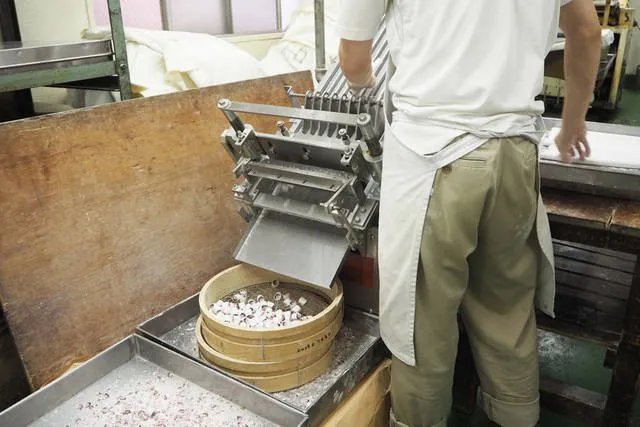 Photograph: This is the machine for slicing candy. By Ayako Takahashi in July 2018
Do You Know That “Kintaro Ame” Is A Registered Trademark?
Kintaro Ame is the candy featuring “wherever you slice, the same face comes out.” That said, when looking at them carefully, each face has a unique expression, such as raising eyebrows or rounder cheeks. Therefore, it is not a total cookie-cutter as none is the same.
The technique they use is called “Kumi Ame”(assembled candy), which was installed by the 2nd owner. It was originated that when they were desperate to create a unique product which their rivals have yet launched, they came across the technique, which was mainly used in the Kansai region. Then, the 2nd owner made his way to learn that skill.
Why did they choose the motif of Kintaro? They wanted to convey their wish that “children grow up in good health” into their product as Kintaro is a strong and healthy boy who can defeat even a bear in Sumo wrestling.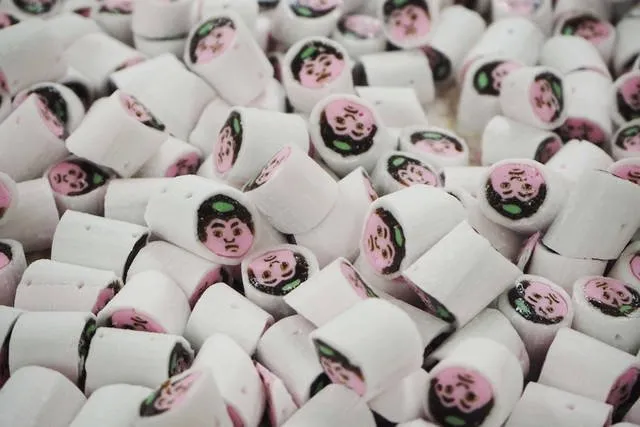 Photograph: Look at it carefully, each facial expression is different. By Ayako Takahashi in July 2018After over 100 years passed since its foundation, “Kintaro Ame” became a registered trademark. However, it is not yet broadly recognized in Japan, as the term, ”Kintaro Ame”, is widely used as a common name. They think it may trigger some problem.
“Without owning a registered trademark, in a case that something happens, we cannot take any actions confidently,” Watanabe said. It appears that the more they expand, the more concerns occur.
We really hope that artisan-made Kintaro Ame will develop more and more to make many people enjoy the candy characterizing a cookie-cutter but not completely identical.
Information
Kintaro Ame Honten Address: 5-16-12 Negishi, Taito-Ku, Tokyo Access: 1 minute from Exit 2 of Hibiya line Minowa station Open: 9:00 am- 17:30 pm Closed: Saturdays (not fixed), Sundays, Public holidays *The information is current as of the time the article was published ### Supervision Provision of Article
URBAN METRO LIFE
ーーーーーーーーーーーーーーー
Tokyo Metro Co., Ltd.
3-19-6, Higashi-ueno, Taito-ku, Tokyo
TEL:+81 FAX:+81 E-mail:
ーーーーーーーーーーーーーーー
© urban life metro 2018