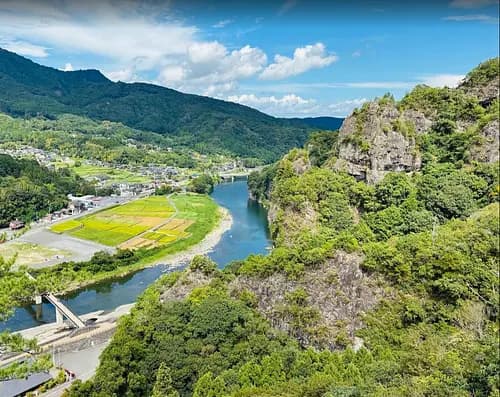
Tosenkyo is a quiet and peaceful gorge in Ibusuki, Kagoshima prefecture. Kagoshima is known for its active volcano and Island called Sakurajima, though our destination Tosenkyo offers to visitors an unique culinary experience in summer.
View on Facebook Part of the Satsuma peninsula, Tosenkyo is a wonderful gorge located in Ibusuki, a lively city in Kagoshima, Kyushuu's southmost prefecture. Just standing on Satsuma peninsula's bayside areas, visitors can appreciate the beautiful sight of Kagoshima bay and admire the profile of Mt.Sakurajima, one of Japan's most famous active volcanos. One could say that Ibusuki's area has been literally blessed by nature: within a relatively limited area we can find Lake Ikeda, the biggest crater lake in Kyushu, Mt. Kaimondake and Mt.Uomidake as well as many other natural sites. Just a few minutes away from Lake Ikeda lies our destination, Tosenkyo's gorge. Tosenkyo's name is originally rooted from the area's historical background. Long ago, when the gorge was still forming, and the coastal line still resembled that of a bay; Tang's imperial ships used it as a wharf for their voyages from and to China. Thus, locals started calling the area Tosengasako, after the Tang's (To) ships (sen), with gasako meaning valley in Kyushu and Western Japan's dialect. And Kyo means a gorge in Japanese. Tosenkyo owes its fame to its pure water, which in 2008 was designated as one Japan's 100 best spring waters. The quantity of spring water that flows from this area has been measured at approximately 100 thousand tons per day, and the water temperature stays at 13 degree Celsius all year long. Since Meiji era (1868-1912), Tosenkyo communities have been working to preserve the qualities of its natural resources, and the beauty of its landscape keeping the area clean and intact. Still, Tosenkyo is not just nature, and like most of places in Japan, it has its speciality dish: Nagashi Somen.Nagashi Somen, What Are You By the Way?
Somen is a kind of noodle generally consumed in summer. It is made out of wheat flour, and its texture is very light and smooth resembling Italian capellini: it could also be compared to Asian glass noodles, despite being a little bit thinner, but unlike those noodles Somen is usually served cold.
Eating Nagashi Somen in an open air setting is a common way of avoiding the heat of the Japanese summer, and it is an especially popular activity in gorges or along the river districts. The way we eat Nagashi Somen is very simple: we dip the noodles in their sauce (Tsuyu), a soy sauce based cold fish stock mix, and eat them right away. Somen is often served with other seasonings (Yakumi), like wasabi, ginger or Japanese ginger. The combination of aromatic and tangy flavored Yakumi and Somen is key to fully enjoying the refreshing atmosphere in Tosenkyo.
Swirling in the Gorge, Origin of Nagashi Somen
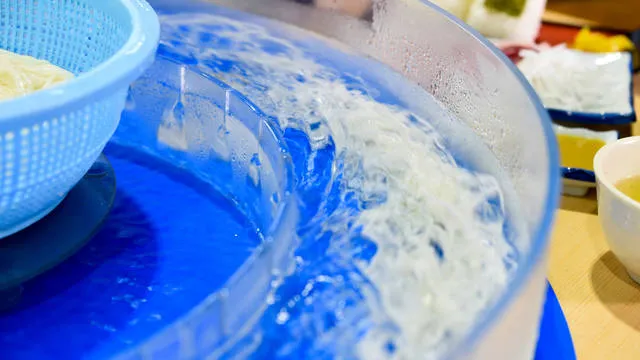
What makes Nagashi Somen in Tosenkyo a unique experience is the way they serve it: usually Nagashi Somen is eaten directly as it's streaming down a bamboo slide, while here in Tosenkyo, the most common way that it is served, is by a machine called Somennagashiki, which originated in this particular area.
Despite not looking particularly sophisticated, this machine is a patented product designed with the sole use of serving Somen.
Tosenkyo is home to one of the most famous Nagashi Somen restaurants in Japan, the Shiei Tosenkyo Somen Nagashi.
In its openair terrace the restaurant's guests can taste Nagashi Somen surrounded by the cool fresh air coming from the gorge, and each table is equipped with its own Somennagashiki: the Somen noodles will flow right in front of the guests only waiting to be caught by their chopsticks.
The true charm of this experience lies not only in spending time together with one's friends or families at the dinner table and trying to catch fresh water noodles, but also an encounter a relaxing and peaceful atmosphere by appreciating the beauty of the fresh spring water, immerse yourself in the aroma of the cedar woods and listen to the therapeutic sounds coming from the gorge.
Besides Nagashi Somen, the restaurant offers a variety of local traditional dishes, such as simmered carp in miso soup (Koikoku) and carp sashimi (Koiarai). Not far from the restaraunt there is also a shrine situated over a tranquil pond where carps, trouts and sturgeons happily swim around in the crystal clear water: this spring water welling from this pond is potable, so visitors can fill up their empty bottles and enjoy drinking it during the stroll.
Tosenkyo is open to tourists all year round, and its features can be admired during each of the four seasons.
Food Facts around Tosenkyo and Ibusuki
Locally grown product that can be found in Tosenkyo is fresh wasabi.
In order to cultivate quality aromatic wasabi, many special conditions are required: besides high soil fertility, pure and fresh water sources are of vital importance, while water temperature must stay within a determined range all year long. Wasabi is indeed a very delicate plant, and the fact that it can be grown in Tosenkyo tells us a lot about the state of its natural resources.
Other than Tosenkyo, the whole Ibusuki area is also known for its rich food culture, from broad bean based desserts to Onsen Tamago, eggs slowly boiled in hot spring water. Discovering local quality food is always a nice way to spice up one's trip.
The roadside station called Michi no Eki is also certainly worth a visit: usually packed with a wide selection of local products to choose from, it is also a good information center for any information about the area. There are two of these roadside stations in Ibusuki, and they offer various seasonal goods and snacks, includes the intriguing okura and loquat flavored ice cream or the Katsuoyaki, a fish shaped cake with a filling of sweetened broad bean and yam paste.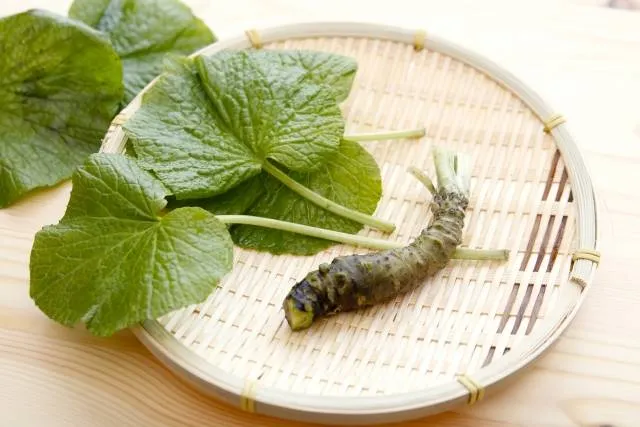
Ibusuki is Full of Unique Attractions
The city of Ibusuki has many other colorful attractions aside from Tosenkyo.
Among other natural places of interest, like the scenic panorama of the Satsuma peninsula and the Kaimondake natural park, Surigahama with its sand hot spring (Sunamushiburo) is also worth mentioning. Due to the presence of formerly active volcanos, Ibusuki has a lot to offer in terms of hot springs (Onsen), and the one in Surigahama stands out because of its very unique features. Instead of bathing in water as one would in any of Japan's other hot springs, visitors at Surigahama have the rare chance of bathing under an hot sand bed: just after 10 minutes of sandbathing,visitors will certainly be overwhelmed by its benefical effects. It really is a very peculiar experience to relax after a long day spent exploring Ibusuki and its surroundings!
How to visit?
◼Name of the Restaurant : Shiei Tosenkyo Somen Nagashi ◼Address: 5967 Kaimonjutchō, Ibusuki-shi, Kagoshima-ken ◼TEL : 0993-32-2143 ◼Opening Hours spring / autumn season : 10:00-17:30 (L.O. 17:00) summer season : 10:00-20:00 (L.O. 19:30) winter season : 10:00-15:30 (L.O. 15:00) *It may vary each yearFrom JR Ibusuki station : 30 minutes by Kagoshima Kotsu bus
From Kagoshima airport : 2 hours by car
Reference List
http://www.kagoshima-kankou.com/
http://www.ibusuki.or.jp/
https://www.e-soumen.net/contents/concept/
写真提供:公益社団法人 鹿児島県観光連盟