This article features, unique wooden bridges, famous in Japan and their history. Including Horai Bridge in Shizuoka, the Guinness certified world’s longest wooden bridge.
Summary
This article features, unique wooden bridges, famous in Japan and their history. Including Horai Bridge in Shizuoka, the Guinness certified world’s longest wooden bridge. The Horai Bridge at 897 meters long is the longest wooden pedestrian bridge in the world. Completed in 1879, this famous wooden bridge is often used as a TV and Film location. It is believed that walking along this bridge will bring you a long life. Why don’t you visit this world record bridge in Shizuoka?
3 Famous Wooden Bridges in Japan
Kintai Bridge, Yamaguchi
via www.photo-ac.com
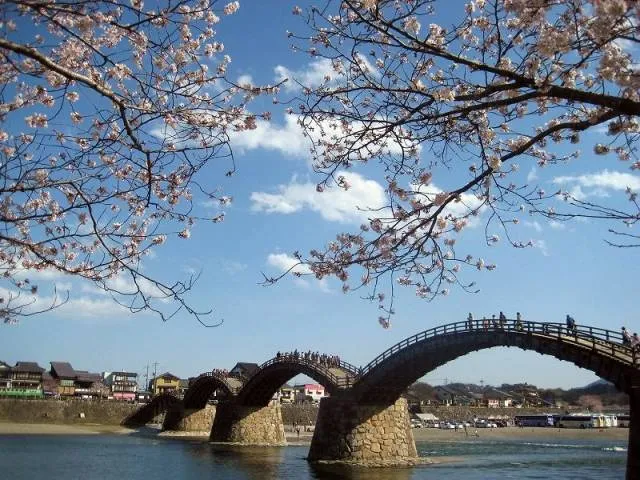
Kintai Bridge is a wooden arch bridge spanning over the Nishiki River in Iwakuni City in Yamaguchi Prefecture. The Kintai Bridge was built in 1673, however the whole bridge was destroyed by the powerful typhoon in 1950. The current bridge was built in 1953 to restore its original state. It consists of five wooden arches lying on four stone piers. This architectural design is one of the most unique ones in the world.
Tsurunomai Bridge, Aomori
via www.photo-ac.com
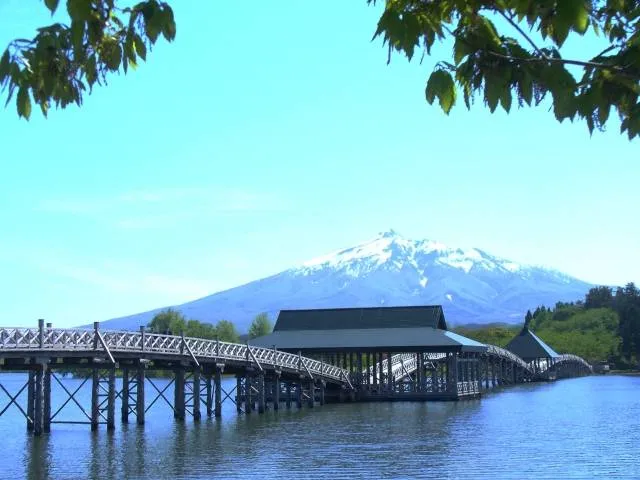
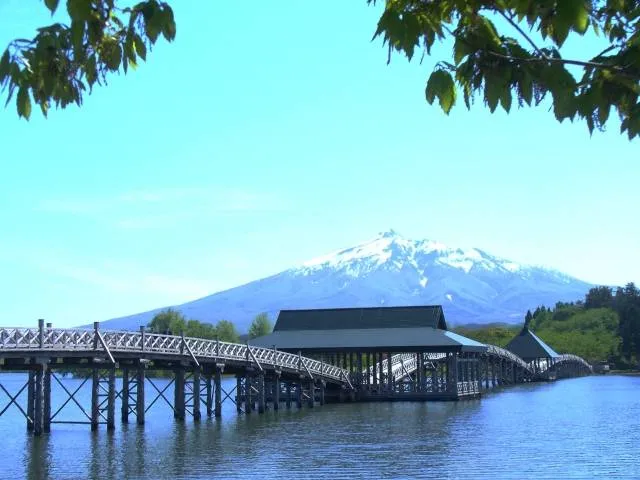
Tsurunomai Bridge is a 984 ft (300 m) wooden bridge passing over the Tsugaru Fujimi Lake in Tsuruta Town in Aomori Prefecture. It is Japan’s longest triple arch wooden bridge. The name “Tsurunomai (dance of cranes)” comes from the bridge’s appearance resembling cranes flying with Mt. Iwaki as the background.
Saru Bridge, Yamanashi
via www.photo-ac.com
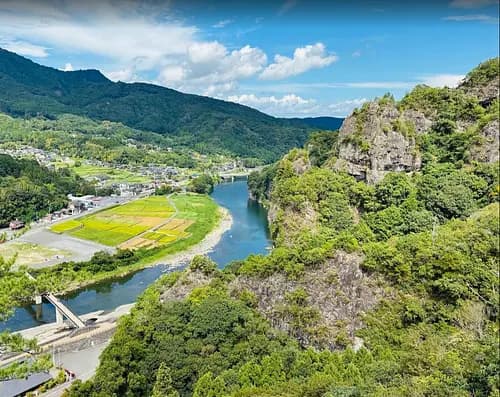
Saru Bridge is a historical wooden bridge lying over the Katsura River in Otsuki City in Yamanashi Prefecture. It is known as one of the three most unique bridges in Japan due to its characteristic architecture. The bridge does not have piers as it connects two high cliffs at 31 meters high from the water. It is supported by the wooden supporting parts at each end. You can enjoy the fantastic view with colored leaves during autumn!
Horai Bridge: Longest Wooden Bridge in the World
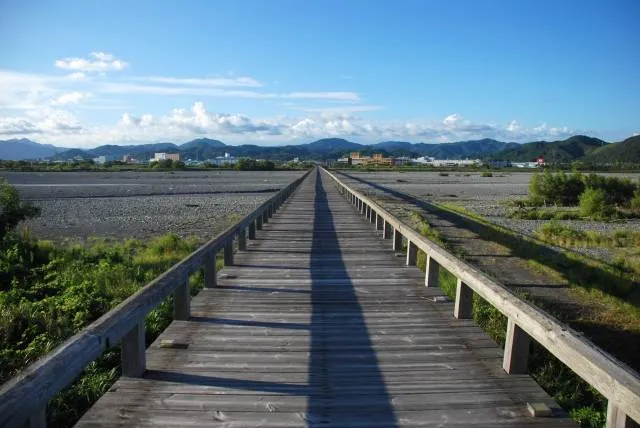
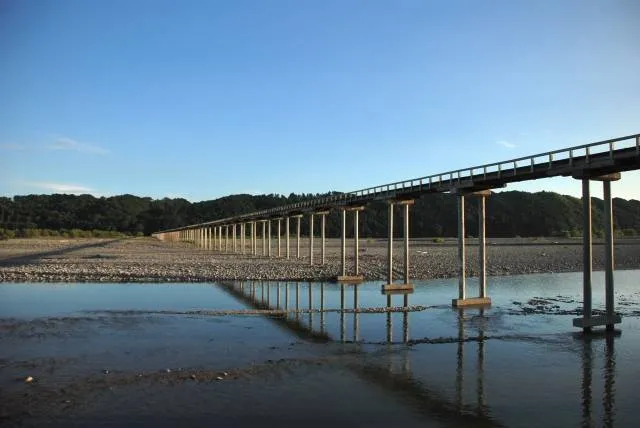
On top of those amazing bridges introduced above, one of the most famous bridges is the Horai Bridge in Shimada City, Shizuoka. The Horai Bridge in Shizuoka Prefecture on the southern coast of Japan’s main Honshu Island is the longest wooden pedestrian bridge in the world. This bridge is often used as a location for Japanese Film and TV for its history and unique appearance. It is 897 meters long and was recognized as the world’s longest by the Guinness Book of Records in 1997.
History of the Horai Bridge and the River Ooi
There used to be no bridges at all, across the River Ooi. This is because rivers, especially larger rivers like the River Ooi were very important defensive features. So the River Ooi was left as deliberately difficult to cross to slow down any enemy army advancing on Edo (present day Tokyo). The River Ooi starts at the top of Mt Ainodake, the 3rd highest peak in Japan at 3,189 meters, and after heavy rain, it would often flood becoming treacherous to cross. Those who wished to cross the river would have to wait for the water level to drop low enough to ford, or those with money could pay ferrymen to carry them and their goods across the river.
Following the Meiji Restoration in 1868 and the fall of the Shogunate, all clans were abolished. The Samurai in the area who had all lost their living began growing tea. As crossing the River Ooi was so difficult and dangerous, these farmers then petitioned the Governor of Shizuoka Prefecture to build a bridge across the Ooi. This bridge became the Horai Bridge and construction was completed in 1879, 11 years after the fall of the Shogunate.
The bridge was originally entirely wooden; however, it was repeatedly damaged by the swelling and flooding of the River Ooi following heavy rains. As a result of this, the bridge’s supports were replaced with concrete ones in 1965.
Importance of the Horai Bridge
Shimada City sits along the old Tokaido highway, between Kyoto and Tokyo. Historically one of the most important roads in Japan connecting the old capital and the new. It is now known as the Japanese National Highway Route 1.
The Fifty-three Stations of the Tōkaidō by Hiroshige - Shimada
How the bridge-less river looked during the Edo Period
Back in the Edo Period, before the construction of the Horai bridge, travelers would have to resort less convenient and possibly dangerous methods of crossing the river. The ukiyo-e artist, Hiroshige (1787-1858) depicts the scene of travelers crossing the River Ooi in one of his more famous works. Being one of the stations on such an important road you can imagine how much people’s lives were made easier by the construction of the Horai Bridge.
Dimensions of this Guinness-certified bridge
The Horai Bridge is 0.5 mi (897.4 m) long and 9.4 ft (2.87 m) wide. It was recognised by the Guinness Book of World Records as the longest pedestrian wooden bridge in the world on December 30th 1997. Only pedestrians and cyclists are allowed to cross and there is a toll of 100 yen for adults, or 10 yen for children of elementary school age. As the rail is quite low, be careful when crossing especially if it is a windy day. The Horai Bridge has also featured in several Japanese films and TV shows. It became widely known in Japan for its unique, quaint appearance and the extraordinary length attracts many tourists from inside and outside of Japan. The bridge is also illuminated with green lights at night creating a peaceful atmosphere.
Power Spot for a Long Happy Life!
via www.photo-ac.com
The Horai Bridge is believed to be a “power spot” in Japan because its length, 897.4m, can be read “ya-ku-na-shi” in Japanese, literally meaning no misfortune. Also, it is a long (“nagai”) wooden (“ki-no”) bridge (“hashi”) = “nagaiki no hashi”, which can also be translated as a bridge of long life. For these reasons, walking across the Horai Bridge is thought to make you live a long happy life. This could just be a coincidence or a play on words…but there is only one way to find out, to visit the Horai Bridge!
The Horai Bridge 897.4 Café was newly opened in March 2018 where you can enjoy the premium Japanese tea produced in Shimada City as well as buying local souvenirs. It is located at the start of the bridge and offers outdoor and indoor seating, so you can have a nice tea break before or after crossing the bridge.
If you are lucky, on a sunny day you can see the Mt. Fuji in the distance from the middle of the bridge! Why don’t you visit Shimada City in Shizuoka to experience the “Nagaiki” Horai Bridge, the longest wooden pedestrian bridge in the world!
Information
From Tokyo to Shizuoka
It takes about 1 hour and 20 minutes by Shinkansen (bullet train) from Tokyo Station to Shizuoka Station
How to Get to Horai Bridge
By Car
It is about a 40-minute drive from Shizuoka Station to the Horai Bridge. There are free parking spots nearby the bridge.
By Public Transportation
Take a JR Tokaido Line train bound for Hamamatsu from Shizuoka Station. Then get off at Shimada Station (about a 25-minute journey). The Horai Bridge is about a 20-minute walk away from the station.
Address: 2-22-14 Minami, Shimada, Shizuoka Prefecture 427-0017
Tel: +81 90-7866-1056